Understanding reality through algorithms

Although Fernanda De La Torre still has several years left in her graduate studies, she’s already dreaming big when it comes to what the future has in store for her.

“I dream of opening up a school one day where I could bring this world of understanding of cognition and perception into places that would never have contact with this,” she says.

It’s that kind of ambitious thinking that’s gotten De La Torre, a doctoral student in MIT’s Department of Brain and Cognitive Sciences, to this point. A recent recipient of the prestigious Paul and Daisy Soros Fellowship for New Americans, De La Torre has found at MIT a supportive, creative research environment that’s allowed her to delve into the cutting-edge science of artificial intelligence. But she’s still driven by an innate curiosity about human imagination and a desire to bring that knowledge to the communities in which she grew up.

An unconventional path to neuroscience

De La Torre’s first exposure to neuroscience wasn’t in the classroom, but in her daily life. As a child, she watched her younger sister struggle with epilepsy. At 12, she crossed into the United States from Mexico illegally to reunite with her mother, exposing her to a whole new language and culture. Once in the States, she had to grapple with her mother’s shifting personality in the midst of an abusive relationship. “All of these different things I was seeing around me drove me to want to better understand how psychology works,” De La Torre says, “to understand how the mind works, and how it is that we can all be in the same environment and feel very different things.”

But finding an outlet for that intellectual curiosity was challenging. As an undocumented immigrant, her access to financial aid was limited. Her high school was also underfunded and lacked elective options. Mentors along the way, though, encouraged the aspiring scientist, and through a program at her school, she was able to take community college courses to fulfill basic educational requirements.

It took an inspiring amount of dedication to her education, but De La Torre made it to Kansas State University for her undergraduate studies, where she majored in computer science and math. At Kansas State, she was able to get her first real taste of research. “I was just fascinated by the questions they were asking and this entire space I hadn’t encountered,” says De La Torre of her experience working in a visual cognition lab and discovering the field of computational neuroscience.

Although Kansas State didn’t have a dedicated neuroscience program, her research experience in cognition led her to a machine learning lab led by William Hsu, a computer science professor. There, De La Torre became enamored by the possibilities of using computation to model the human brain. Hsu’s support also convinced her that a scientific career was a possibility. “He always made me feel like I was capable of tackling big questions,” she says fondly.

With the confidence imparted in her at Kansas State, De La Torre came to MIT in 2019 as a post-baccalaureate student in the lab of Tomaso Poggio, the Eugene McDermott Professor of Brain and Cognitive Sciences and an investigator at the McGovern Institute for Brain Research. With Poggio, also the director of the Center for Brains, Minds and Machines, De La Torre began working on deep-learning theory, an area of machine learning focused on how artificial neural networks modeled on the brain can learn to recognize patterns and learn.

“It’s a very interesting question because we’re starting to use them everywhere,” says De La Torre of neural networks, listing off examples from self-driving cars to medicine. “But, at the same time, we don’t fully understand how these networks can go from knowing nothing and just being a bunch of numbers to outputting things that make sense.”

Her experience as a post-bac was De La Torre’s first real opportunity to apply the technical computer skills she developed as an undergraduate to neuroscience. It was also the first time she could fully focus on research. “That was the first time that I had access to health insurance and a stable salary. That was, in itself, sort of life-changing,” she says. “But on the research side, it was very intimidating at first. I was anxious, and I wasn’t sure that I belonged here.”

Fortunately, De La Torre says she was able to overcome those insecurities, both through a growing unabashed enthusiasm for the field and through the support of Poggio and her other colleagues in MIT’s Department of Brain and Cognitive Sciences. When the opportunity came to apply to the department’s PhD program, she jumped on it. “It was just knowing these kinds of mentors are here and that they cared about their students,” says De La Torre of her decision to stay on at MIT for graduate studies. “That was really meaningful.”

Expanding notions of reality and imagination

In her two years so far in the graduate program, De La Torre’s work has expanded the understanding of neural networks and their applications to the study of the human brain. Working with Guangyu Robert Yang, an associate investigator at the McGovern Institute and an assistant professor in the departments of Brain and Cognitive Sciences and Electrical Engineering and Computer Sciences, she’s engaged in what she describes as more philosophical questions about how one develops a sense of self as an independent being. She’s interested in how that self-consciousness develops and why it might be useful.

De La Torre’s primary advisor, though, is Professor Josh McDermott, who leads the Laboratory for Computational Audition. With McDermott, De La Torre is attempting to understand how the brain integrates vision and sound. While combining sensory inputs may seem like a basic process, there are many unanswered questions about how our brains combine multiple signals into a coherent impression, or percept, of the world. Many of the questions are raised by audiovisual illusions in which what we hear changes what we see. For example, if one sees a video of two discs passing each other, but the clip contains the sound of a collision, the brain will perceive that the discs are bouncing off, rather than passing through each other. Given an ambiguous image, that simple auditory cue is all it takes to create a different perception of reality.

There’s something interesting happening where our brains are receiving two signals telling us different things and, yet, we have to combine them somehow to make sense of the world.

De La Torre is using behavioral experiments to probe how the human brain makes sense of multisensory cues to construct a particular perception. To do so, she’s created various scenes of objects interacting in 3D space over different sounds, asking research participants to describe characteristics of the scene. For example, in one experiment, she combines visuals of a block moving across a surface at different speeds with various scraping sounds, asking participants to estimate how rough the surface is. Eventually she hopes to take the experiment into virtual reality, where participants will physically push blocks in response to how rough they perceive the surface to be, rather than just reporting on what they experience.

Once she’s collected data, she’ll move into the modeling phase of the research, evaluating whether multisensory neural networks perceive illusions the way humans do. “What we want to do is model exactly what’s happening,” says De La Torre. “How is it that we’re receiving these two signals, integrating them and, at the same time, using all of our prior knowledge and inferences of physics to really make sense of the world?”

Although her two strands of research with Yang and McDermott may seem distinct, she sees clear connections between the two. Both projects are about grasping what artificial neural networks are capable of and what they tell us about the brain. At a more fundamental level, she says that how the brain perceives the world from different sensory cues might be part of what gives people a sense of self. Sensory perception is about constructing a cohesive, unitary sense of the world from multiple sources of sensory data. Similarly, she argues, “the sense of self is really a combination of actions, plans, goals, emotions, all of these different things that are components of their own, but somehow create a unitary being.”

It’s a fitting sentiment for De La Torre, who has been working to make sense of and integrate different aspects of her own life. Working in the Computational Audition lab, for example, she’s started experimenting with combining electronic music with folk music from her native Mexico, connecting her “two worlds,” as she says. Having the space to undertake those kinds of intellectual explorations, and colleagues who encourage it, is one of De La Torre’s favorite parts of MIT.

“Beyond professors, there’s also a lot of students whose way of thinking just amazes me,” she says. “I see a lot of goodness and excitement for science and a little bit of — it’s not nerdiness, but a love for very niche things — and I just kind of love that.”
Nidhi Seethapathi

Science in Motion

The computational models that Seethapathi builds in her lab aim to predict how humans will move under different conditions. If a person is placed in an unfamiliar environment and asked to navigate a course under time pressure, what path will they take? How will they move their limbs, and what forces will they exert? How will their movements change as they become more comfortable on the terrain?

Seethapathi uses the principles of robotics to build models that answer these questions, then tests them by placing real people in the same scenarios and monitoring their movements. Currently, most of these tests take place in her lab, where subjects are often limited to simple tasks like walking on a treadmill. As she expands her models to predict more complex movements, she will begin monitoring people’s activity in the real world, over longer time periods than laboratory experiments typically allow. Ultimately, Seethapathi hopes her findings will inform the way doctors, therapists, and engineers help patients regain control over their movements after an injury or due to a movement disorder.

Modeling the social mind

Typically, it would take two graduate students to do the research that Setayesh Radkani is doing.

Driven by an insatiable curiosity about the human mind, she is working on two PhD thesis projects in two different cognitive neuroscience labs at MIT. For one, she is studying punishment as a social tool to influence others. For the other, she is uncovering the neural processes underlying social learning — that is, learning from others. By piecing together these two research programs, Radkani is hoping to gain a better understanding of the mechanisms underpinning social influence in the mind and brain.

Radkani lived in Iran for most of her life, growing up alongside her younger brother in Tehran. The two spent a lot of time together and have long been each other’s best friends. Her father is a civil engineer, and her mother is a midwife. Her parents always encouraged her to explore new things and follow her own path, even if it wasn’t quite what they imagined for her. And her uncle helped cultivate her sense of curiosity, teaching her to “always ask why” as a way to understand how the world works.

Growing up, Radkani most loved learning about human psychology and using math to model the world around her. But she thought it was impossible to combine her two interests. Prioritizing math, she pursued a bachelor’s degree in electrical engineering at the Sharif University of Technology in Iran.

Then, late in her undergraduate studies, Radkani took a psychology course and discovered the field of cognitive neuroscience, in which scientists mathematically model the human mind and brain. She also spent a summer working in a computational neuroscience lab at the Swiss Federal Institute of Technology in Lausanne. Seeing a way to combine her interests, she decided to pivot and pursue the subject in graduate school.

An experience leading a project in her engineering ethics course during her final year of undergrad further helped her discover some of the questions that would eventually form the basis of her PhD. The project investigated why some students cheat and how to change this.

“Through this project I learned how complicated it is to understand the reasons that people engage in immoral behavior, and even more complicated than that is how to devise policies and react in these situations in order to change people’s attitudes,” Radkani says. “It was this experience that made me realize that I’m interested in studying the human social and moral mind.”

She began looking into social cognitive neuroscience research and stumbled upon a relevant TED talk by Rebecca Saxe, the John W. Jarve Professor in Brain and Cognitive Sciences at MIT, who would eventually become one of Radkani’s research advisors. Radkani knew immediately that she wanted to work with Saxe. But she needed to first get into the BCS PhD program at MIT, a challenging obstacle given her minimal background in the field.

After two application cycles and a year’s worth of graduate courses in cognitive neuroscience, Radkani was accepted into the program. But to come to MIT, she had to leave her family behind. Coming from Iran, Radkani has a single-entry visa, making it difficult for her to travel outside the U.S. She hasn’t been able to visit her family since starting her PhD and won’t be able to until at least after she graduates. Her visa also limits her research contributions, restricting her from attending conferences outside the U.S. “That is definitely a huge burden on my education and on my mental health,” she says.

Still, Radkani is grateful to be at MIT, indulging her curiosity in the human social mind. And she’s thankful for her supportive family, who she calls over FaceTime every day.

Modeling how people think about punishment

In Saxe’s lab, Radkani is researching how people approach and react to punishment, through behavioral studies and neuroimaging. By synthesizing these findings, she’s developing a computational model of the mind that characterizes how people make decisions in situations involving punishment, such as when a parent disciplines a child, when someone punishes their romantic partner, or when the criminal justice system sentences a defendant. With this model, Radkani says she hopes to better understand “when and why punishment works in changing behavior and influencing beliefs about right and wrong, and why sometimes it fails.”

Punishment isn’t a new research topic in cognitive neuroscience, Radkani says, but in previous studies, scientists have often only focused on people’s behavior in punitive situations and haven’t considered the thought processes that underlie those behaviors. Characterizing these thought processes, though, is key to understanding whether punishment in a situation can be effective in changing people’s attitudes.

People bring their prior beliefs into a punitive situation. Apart from moral beliefs about the appropriateness of different behaviors, “you have beliefs about the characteristics of the people involved, and you have theories about their intentions and motivations,” Radkani says. “All those come together to determine what you do or how you are influenced by punishment,” given the circumstances. Punishers decide a suitable punishment based on their interpretation of the situation, in light of their beliefs. Targets of punishment then decide whether they’ll change their attitude as a result of the punishment, depending on their own beliefs. Even outside observers make decisions, choosing whether to keep or change their moral beliefs based on what they see.

To capture these decision-making processes, Radkani is developing a computational model of the mind for punitive situations. The model mathematically represents people’s beliefs and how they interact with certain features of the situation to shape their decisions. The model then predicts a punisher’s decisions, and how punishment will influence the target and observers. Through this model, Radkani will provide a foundational understanding of how people think in various punitive situations.

Researching the neural mechanisms of social learning

In parallel, working in the lab of Professor Mehrdad Jazayeri, Radkani is studying social learning, uncovering its underlying neural processes. Through social learning, people learn from other people’s experiences and decisions, and incorporate this socially acquired knowledge into their own decisions or beliefs.

Humans are extraordinary in their social learning abilities, however our primary form of learning, shared by all other animals, is learning from self-experience. To investigate how learning from others is similar to or different from learning from our own experiences, Radkani has designed a two-player video game that involves both types of learning. During the game, she and her collaborators in Jazayeri’s lab record neural activity in the brain. By analyzing these neural measurements, they plan to uncover the computations carried out by neural circuits during social learning, and compare those to learning from self-experience.

Radkani first became curious about this comparison as a way to understand why people sometimes draw contrasting conclusions from very similar situations. “For example, if I get Covid from going to a restaurant, I’ll blame the restaurant and say it was not clean,” Radkani says. “But if I hear the same thing happen to my friend, I’ll say it’s because they were not careful.” Radkani wanted to know the root causes of this mismatch in how other people’s experiences affect our beliefs and judgements differently from our own similar experiences, particularly because it can lead to “errors that color the way that we judge other people,” she says.

By combining her two research projects, Radkani hopes to better understand how social influence works, particularly in moral situations. From there, she has a slew of research questions that she’s eager to investigate, including: How do people choose who to trust? And which types of people tend to be the most influential? As Radkani’s research grows, so does her curiosity.

These neurons have food on the brain

A gooey slice of pizza. A pile of crispy French fries. Ice cream dripping down a cone on a hot summer day. When you look at any of these foods, a specialized part of your visual cortex lights up, according to a new study from MIT neuroscientists.

This newly discovered population of food-responsive neurons is located in the ventral visual stream, alongside populations that respond specifically to faces, bodies, places, and words. The unexpected finding may reflect the special significance of food in human culture, the researchers say.

“Food is central to human social interactions and cultural practices. It’s not just sustenance,” says Nancy Kanwisher, the Walter A. Rosenblith Professor of Cognitive Neuroscience and a member of MIT’s McGovern Institute for Brain Research and Center for Brains, Minds, and Machines. “Food is core to so many elements of our cultural identity, religious practice, and social interactions, and many other things that humans do.”

The findings, based on an analysis of a large public database of human brain responses to a set of 10,000 images, raise many additional questions about how and why this neural population develops. In future studies, the researchers hope to explore how people’s responses to certain foods might differ depending on their likes and dislikes, or their familiarity with certain types of food.

MIT postdoc Meenakshi Khosla is the lead author of the paper, along with MIT research scientist N. Apurva Ratan Murty. The study appears today in the journal Current Biology.

Visual categories

More than 20 years ago, while studying the ventral visual stream, the part of the brain that recognizes objects, Kanwisher discovered cortical regions that respond selectively to faces. Later, she and other scientists discovered other regions that respond selectively to places, bodies, or words. Most of those areas were discovered when researchers specifically set out to look for them. However, that hypothesis-driven approach can limit what you end up finding, Kanwisher says.

“There could be other things that we might not think to look for,” she says. “And even when we find something, how do we know that that’s actually part of the basic dominant structure of that pathway, and not something we found just because we were looking for it?”

To try to uncover the fundamental structure of the ventral visual stream, Kanwisher and Khosla decided to analyze a large, publicly available dataset of full-brain functional magnetic resonance imaging (fMRI) responses from eight human subjects as they viewed thousands of images.

“We wanted to see when we apply a data-driven, hypothesis-free strategy, what kinds of selectivities pop up, and whether those are consistent with what had been discovered before. A second goal was to see if we could discover novel selectivities that either haven’t been hypothesized before, or that have remained hidden due to the lower spatial resolution of fMRI data,” Khosla says.

To do that, the researchers applied a mathematical method that allows them to discover neural populations that can’t be identified from traditional fMRI data. An fMRI image is made up of many voxels — three-dimensional units that represent a cube of brain tissue. Each voxel contains hundreds of thousands of neurons, and if some of those neurons belong to smaller populations that respond to one type of visual input, their responses may be drowned out by other populations within the same voxel.

The new analytical method, which Kanwisher’s lab has previously used on fMRI data from the auditory cortex, can tease out responses of neural populations within each voxel of fMRI data.

Using this approach, the researchers found four populations that corresponded to previously identified clusters that respond to faces, places, bodies, and words. “That tells us that this method works, and it tells us that the things that we found before are not just obscure properties of that pathway, but major, dominant properties,” Kanwisher says.

Intriguingly, a fifth population also emerged, and this one appeared to be selective for images of food.

“We were first quite puzzled by this because food is not a visually homogenous category,” Khosla says. “Things like apples and corn and pasta all look so unlike each other, yet we found a single population that responds similarly to all these diverse food items.”

The food-specific population, which the researchers call the ventral food component (VFC), appears to be spread across two clusters of neurons, located on either side of the FFA. The fact that the food-specific populations are spread out between other category-specific populations may help explain why they have not been seen before, the researchers say.

“We think that food selectivity had been harder to characterize before because the populations that are selective for food are intermingled with other nearby populations that have distinct responses to other stimulus attributes. The low spatial resolution of fMRI prevents us from seeing this selectivity because the responses of different neural population get mixed in a voxel,” Khosla says.

“The technique which the researchers used to identify category-sensitive cells or areas is impressive, and it recovered known category-sensitive systems, making the food category findings most impressive,” says Paul Rozin, a professor of psychology at the University of Pennsylvania, who was not involved in the study. “I can’t imagine a way for the brain to reliably identify the diversity of foods based on sensory features. That makes this all the more fascinating, and likely to clue us in about something really new.”

Food vs non-food

The researchers also used the data to train a computational model of the VFC, based on previous models Murty had developed for the brain’s face and place recognition areas. This allowed the researchers to run additional experiments and predict the responses of the VFC. In one experiment, they fed the model matched images of food and non-food items that looked very similar — for example, a banana and a yellow crescent moon.

“Those matched stimuli have very similar visual properties, but the main attribute in which they differ is edible versus inedible,” Khosla says. “We could feed those arbitrary stimuli through the predictive model and see whether it would still respond more to food than non-food, without having to collect the fMRI data.”

They could also use the computational model to analyze much larger datasets, consisting of millions of images. Those simulations helped to confirm that the VFC is highly selective for images of food.

From their analysis of the human fMRI data, the researchers found that in some subjects, the VFC responded slightly more to processed foods such as pizza than unprocessed foods like apples. In the future they hope to explore how factors such as familiarity and like or dislike of a particular food might affect individuals’ responses to that food.

They also hope to study when and how this region becomes specialized during early childhood, and what other parts of the brain it communicates with. Another question is whether this food-selective population will be seen in other animals such as monkeys, who do not attach the cultural significance to food that humans do.

The research was funded by the National Institutes of Health, the National Eye Institute, and the National Science Foundation through the MIT Center for Brains, Minds, and Machines.

Whether speaking Turkish or Norwegian, the brain’s language network looks the same

Over several decades, neuroscientists have created a well-defined map of the brain’s “language network,” or the regions of the brain that are specialized for processing language. Found primarily in the left hemisphere, this network includes regions within Broca’s area, as well as in other parts of the frontal and temporal lobes.

However, the vast majority of those mapping studies have been done in English speakers as they listened to or read English texts. MIT neuroscientists have now performed brain imaging studies of speakers of 45 different languages. The results show that the speakers’ language networks appear to be essentially the same as those of native English speakers.

The findings, while not surprising, establish that the location and key properties of the language network appear to be universal. The work also lays the groundwork for future studies of linguistic elements that would be difficult or impossible to study in English speakers because English doesn’t have those features.

“This study is very foundational, extending some findings from English to a broad range of languages,” says Evelina Fedorenko, the Frederick A. and Carole J. Middleton Career Development Associate Professor of Neuroscience at MIT and a member of MIT’s McGovern Institute for Brain Research. “The hope is that now that we see that the basic properties seem to be general across languages, we can ask about potential differences between languages and language families in how they are implemented in the brain, and we can study phenomena that don’t really exist in English.”

Fedorenko is the senior author of the study, which appears today in Nature Neuroscience. Saima Malik-Moraleda, a PhD student in the Speech and Hearing Bioscience and Technology program at Harvard University, and Dima Ayyash, a former research assistant, are the lead authors of the paper.

Mapping language networks

The precise locations and shapes of language areas differ across individuals, so to find the language network, researchers ask each person to perform a language task while scanning their brains with functional magnetic resonance imaging (fMRI). Listening to or reading sentences in one’s native language should activate the language network. To distinguish this network from other brain regions, researchers also ask participants to perform tasks that should not activate it, such as listening to an unfamiliar language or solving math problems.

Several years ago, Fedorenko began designing these “localizer” tasks for speakers of languages other than English. While most studies of the language network have used English speakers as subjects, English does not include many features commonly seen in other languages. For example, in English, word order tends to be fixed, while in other languages there is more flexibility in how words are ordered. Many of those languages instead use the addition of morphemes, or segments of words, to convey additional meaning and relationships between words.

“There has been growing awareness for many years of the need to look at more languages, if you want make claims about how language works, as opposed to how English works,” Fedorenko says. “We thought it would be useful to develop tools to allow people to rigorously study language processing in the brain in other parts of the world. There’s now access to brain imaging technologies in many countries, but the basic paradigms that you would need to find the language-responsive areas in a person are just not there.”

For the new study, the researchers performed brain imaging of two speakers of 45 different languages, representing 12 different language families. Their goal was to see if key properties of the language network, such as location, left lateralization, and selectivity, were the same in those participants as in people whose native language is English.

The researchers decided to use “Alice in Wonderland” as the text that everyone would listen to, because it is one of the most widely translated works of fiction in the world. They selected 24 short passages and three long passages, each of which was recorded by a native speaker of the language. Each participant also heard nonsensical passages, which should not activate the language network, and was asked to do a variety of other cognitive tasks that should not activate it.

The team found that the language networks of participants in this study were found in approximately the same brain regions, and had the same selectivity, as those of native speakers of English.

“Language areas are selective,” Malik-Moraleda says. “They shouldn’t be responding during other tasks such as a spatial working memory task, and that was what we found across the speakers of 45 languages that we tested.”

Additionally, language regions that are typically activated together in English speakers, such as the frontal language areas and temporal language areas, were similarly synchronized in speakers of other languages.

The researchers also showed that among all of the subjects, the small amount of variation they saw between individuals who speak different languages was the same as the amount of variation that would typically be seen between native English speakers.

Similarities and differences

While the findings suggest that the overall architecture of the language network is similar across speakers of different languages, that doesn’t mean that there are no differences at all, Fedorenko says. As one example, researchers could now look for differences in speakers of languages that predominantly use morphemes, rather than word order, to help determine the meaning of a sentence.

“There are all sorts of interesting questions you can ask about morphological processing that don’t really make sense to ask in English, because it has much less morphology,” Fedorenko says.

Another possibility is studying whether speakers of languages that use differences in tone to convey different word meanings would have a language network with stronger links to auditory brain regions that encode pitch.

Right now, Fedorenko’s lab is working on a study in which they are comparing the ‘temporal receptive fields’ of speakers of six typologically different languages, including Turkish, Mandarin, and Finnish. The temporal receptive field is a measure of how many words the language processing system can handle at a time, and for English, it has been shown to be six to eight words long.

“The language system seems to be working on chunks of just a few words long, and we’re trying to see if this constraint is universal across these other languages that we’re testing,” Fedorenko says.

The researchers are also working on creating language localizer tasks and finding study participants representing additional languages beyond the 45 from this study.

The research was funded by the National Institutes of Health and research funds from MIT’s Department of Brain and Cognitive Sciences, the McGovern Institute, and the Simons Center for the Social Brain. Malik-Moraleda was funded by a la Caixa Fellowship and a Friends of McGovern fellowship.

Artificial neural networks model face processing in autism

Many of us easily recognize emotions expressed in others’ faces. A smile may mean happiness, while a frown may indicate anger. Autistic people often have a more difficult time with this task. It’s unclear why. But new research, published today in The Journal of Neuroscience, sheds light on the inner workings of the brain to suggest an answer. And it does so using a tool that opens new pathways to modeling the computation in our heads: artificial intelligence.

Researchers have primarily suggested two brain areas where the differences might lie. A region on the side of the primate (including human) brain called the inferior temporal (IT) cortex contributes to facial recognition. Meanwhile, a deeper region called the amygdala receives input from the IT cortex and other sources and helps process emotions.

Kohitij Kar, a research scientist in the lab of MIT Professor James DiCarlo, hoped to zero in on the answer. (DiCarlo, the Peter de Florez Professor in the Department of Brain and Cognitive Sciences, is a member of the McGovern Institute for Brain Research and director of MIT’s Quest for Intelligence.)

Kar began by looking at data provided by two other researchers: Shuo Wang, at Washington University in St. Louis, and Ralph Adolphs, at the California Institute of Technology. In one experiment, they showed images of faces to autistic adults and to neurotypical controls. The images had been generated by software to vary on a spectrum from fearful to happy, and the participants judged, quickly, whether the faces depicted happiness. Compared with controls, autistic adults required higher levels of happiness in the faces to report them as happy.

Modeling the brain

Kar, who is also a member of the Center for Brains, Minds and Machines, trained an artificial neural network, a complex mathematical function inspired by the brain’s architecture, to perform the same task. The network contained layers of units that roughly resemble biological neurons that process visual information. These layers process information as it passes from an input image to a final judgment indicating the probability that the face is happy. Kar found that the network’s behavior more closely matched the neurotypical controls than it did the autistic adults.

The network also served two more interesting functions. First, Kar could dissect it. He stripped off layers and retested its performance, measuring the difference between how well it matched controls and how well it matched autistic adults. This difference was greatest when the output was based on the last network layer. Previous work has shown that this layer in some ways mimics the IT cortex, which sits near the end of the primate brain’s ventral visual processing pipeline. Kar’s results implicate the IT cortex in differentiating neurotypical controls from autistic adults.

The other function is that the network can be used to select images that might be more efficient in autism diagnoses. If the difference between how closely the network matches neurotypical controls versus autistic adults is greater when judging one set of images versus another set of images, the first set could be used in the clinic to detect autistic behavioral traits. “These are promising results,” Kar says. Better models of the brain will come along, “but oftentimes in the clinic, we don’t need to wait for the absolute best product.”

Next, Kar evaluated the role of the amygdala. Again, he used data from Wang and colleagues. They had used electrodes to record the activity of neurons in the amygdala of people undergoing surgery for epilepsy as they performed the face task. The team found that they could predict a person’s judgment based on these neurons’ activity. Kar re-analyzed the data, this time controlling for the ability of the IT-cortex-like network layer to predict whether a face truly was happy. Now, the amygdala provided very little information of its own. Kar concludes that the IT cortex is the driving force behind the amygdala’s role in judging facial emotion.

Noisy networks

Finally, Kar trained separate neural networks to match the judgments of neurotypical controls and autistic adults. He looked at the strengths or “weights” of the connections between the final layers and the decision nodes. The weights in the network matching autistic adults, both the positive or “excitatory” and negative or “inhibitory” weights, were weaker than in the network matching neurotypical controls. This suggests that sensory neural connections in autistic adults might be noisy or inefficient.

To further test the noise hypothesis, which is popular in the field, Kar added various levels of fluctuation to the activity of the final layer in the network modeling autistic adults. Within a certain range, added noise greatly increased the similarity between its performance and that of the autistic adults. Adding noise to the control network did much less to improve its similarity to the control participants. This further suggest that sensory perception in autistic people may be the result of a so-called “noisy” brain.

Computational power

Looking forward, Kar sees several uses for computational models of visual processing. They can be further prodded, providing hypotheses that researchers might test in animal models. “I think facial emotion recognition is just the tip of the iceberg,” Kar says. They can also be used to select or even generate diagnostic content. Artificial intelligence could be used to generate content like movies and educational materials that optimally engages autistic children and adults. One might even tweak facial and other relevant pixels in what autistic people see in augmented reality goggles, work that Kar plans to pursue in the future.

Ultimately, Kar says, the work helps to validate the usefulness of computational models, especially image-processing neural networks. They formalize hypotheses and make them testable. Does one model or another better match behavioral data? “Even if these models are very far off from brains, they are falsifiable, rather than people just making up stories,” he says. “To me, that’s a more powerful version of science.”

Approaching human cognition from many angles

In January, as the Charles River was starting to freeze over, Keith Murray and the other members of MIT’s men’s heavyweight crew team took to erging on the indoor rowing machine. For 80 minutes at a time, Murray endured one of the most grueling workouts of his college experience. To distract himself from the pain, he would talk with his teammates, covering everything from great philosophical ideas to personal coffee preferences.

For Murray, virtually any conversation is an opportunity to explore how people think and why they think in certain ways. Currently a senior double majoring in computation and cognition, and linguistics and philosophy, Murray tries to understand the human experience based on knowledge from all of these fields.

“I’m trying to blend different approaches together to understand the complexities of human cognition,” he says. “For example, from a physiological perspective, the brain is just billions of neurons firing all at once, but this hardly scratches the surface of cognition.”

Murray grew up in Corydon, Indiana, where he attended the Indiana Academy for Science, Mathematics, and Humanities during his junior year of high school. He was exposed to philosophy there, learning the ideas of Plato, Socrates, and Thomas Aquinas, to name a few. When looking at colleges, Murray became interested in MIT because he wanted to learn about human thought processes from different perspectives. “Coming to MIT, I knew I wanted to do something philosophical. But I wanted to also be on the more technical side of things,” he says.

Once on campus, Murray immediately pursued an opportunity through the Undergraduate Research Opportunity Program (UROP) in the Digital Humanities Lab. There he worked with language-processing technology to analyze gendered language in various novels, with the end goal of displaying the data for an online audience. He learned about the basic mathematical models used for analyzing and presenting data online, to study the social implications of linguistic phrases and expressions.

Murray also joined the Concourse learning community, which brought together different perspectives from the humanities, sciences, and math in a weekly seminar. “I was exposed to some excellent examples of how to do interdisciplinary work,” he recalls.

In the summer before his sophomore year, Murray took a position as a researcher in the Harnett Lab, where instead of working with novels, he was working with mice. Alongside postdoc Lucas Fisher, Murray trained mice to do navigational tasks using virtual reality equipment. His goal was to explore neural encoding in navigation, understanding why the mice behaved in certain ways after being shown certain stimuli on the screens. Spending time in the lab, Murray became increasingly interested in neuroscience and the biological components behind human thought processes.

He sought out other neuroscience-related research experiences, which led him to explore a SuperUROP project in MIT’s Computer Science and Artificial Intelligence Laboratory (CSAIL). Working under Professor Nancy Lynch, he designed theoretical models of the retina using machine learning. Murray was excited to apply the techniques he learned in 9.40 (Introduction to Neural Computation) to address complex neurological problems. Murray considers this one of his most challenging research experiences, as the experience was entirely online.

“It was during the pandemic, so I had to learn a lot on my own; I couldn’t exactly do research in a lab. It was a big challenge, but at the end, I learned a lot and ended up getting a publication out of it,” he reflects.

This past semester, Murray has worked in the lab of Professor Ila Fiete in the McGovern Institute for Brain Research, constructing deep-learning models of animals performing navigational tasks. Through this UROP, which builds on his final project from Fiete’s class 9.49 (Neural Circuits for Cognition), Murray has been working to incorporate existing theoretical models of the hippocampus to investigate the intersection between artificial intelligence and neuroscience.

Reflecting on his varied research experiences, Murray says they have shown him new ways to explore the human brain from multiple perspectives, something he finds helpful as he tries to understand the complexity of human behavior.

Outside of his academic pursuits, Murray has continued to row with the crew team, where he walked on his first year. He sees rowing as a way to build up his strength, both physically and mentally. “When I’m doing my class work or I’m thinking about projects, I am using the same mental toughness that I developed during rowing,” he says. “That’s something I learned at MIT, to cultivate the dedication you put toward something. It’s all the same mental toughness whether you apply it to physical activities like rowing, or research projects.”

Looking ahead, Murray hopes to pursue a PhD in neuroscience, looking to find ways to incorporate his love of philosophy and human thought into his cognitive research. “I think there’s a lot more to do with neuroscience, especially with artificial intelligence. There are so many new technological developments happening right now,” he says.

What words can convey

From search engines to voice assistants, computers are getting better at understanding what we mean. That’s thanks to language processing programs that make sense of a staggering number of words, without ever being told explicitly what those words mean. Such programs infer meaning instead through statistics—and a new study reveals that this computational approach can assign many kinds of information to a single word, just like the human brain.

The study, published April 14, 2022, in the journal Nature Human Behavior, was co-led by Gabriel Grand, a graduate student at MIT’s Computer Science and Artificial Intelligence Laboratory, and Idan Blank, an assistant professor at the University of California, Los Angeles, and supervised by McGovern Investigator Ev Fedorenko, a cognitive neuroscientist who studies how the human brain uses and understands language, and Francisco Pereira at the National Institute of Mental Health. Fedorenko says the rich knowledge her team was able to find within computational language models demonstrates just how much can be learned about the world through language alone.

Early language models

The research team began its analysis of statistics-based language processing models in 2015, when the approach was new. Such models derive meaning by analyzing how often pairs of words co-occur in texts and using those relationships to assess the similarities of words’ meanings. For example, such a program might conclude that “bread” and “apple” are more similar to one another than they are to “notebook,” because “bread” and “apple” are often found in proximity to words like “eat” or “snack,” whereas “notebook” is not.

The models were clearly good at measuring words’ overall similarity to one another. But most words carry many kinds of information, and their similarities depend on which qualities are being evaluated. “Humans can come up with all these different mental scales to help organize their understanding of words,” explains Grand, a former undergraduate researcher in the Fedorenko lab. For examples, he says, “dolphins and alligators might be similar in size, but one is much more dangerous than the other.”

Grand and Idan Blank, who was then a graduate student at the McGovern Institute, wanted to know whether the models captured that same nuance. And if they did, how was the information organized?

To learn how the information in such a model stacked up to humans’ understanding of words, the team first asked human volunteers to score words along many different scales: Were the concepts those words conveyed big or small, safe or dangerous, wet or dry? Then, having mapped where people position different words along these scales, they looked to see whether language processing models did the same.

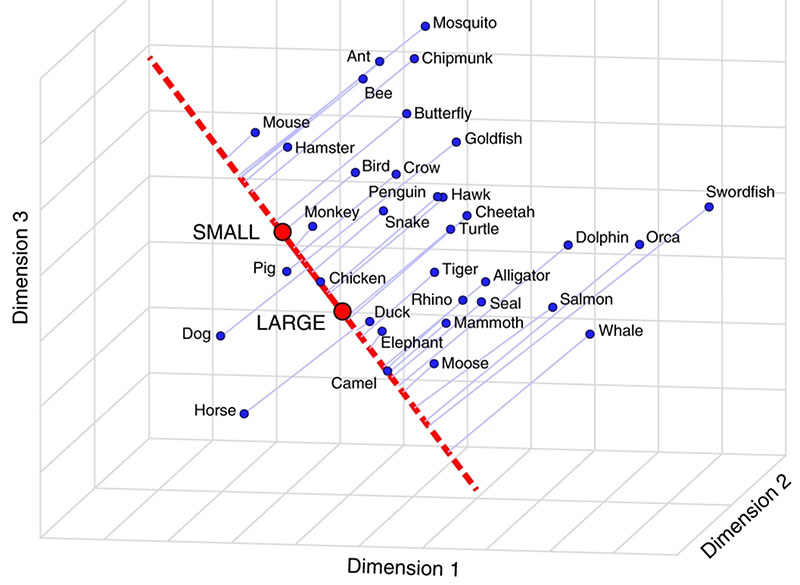
Grand explains that distributional semantic models use co-occurrence statistics to organize words into a huge, multidimensional matrix. The more similar words are to one another, the closer they are within that space. The dimensions of the space are vast, and there is no inherent meaning built into its structure. “In these word embeddings, there are hundreds of dimensions, and we have no idea what any dimension means,” he says. “We’re really trying to peer into this black box and say, ‘is there structure in here?’”

Word-vectors in the category ‘animals’ (blue circles) are orthogonally projected (light-blue lines) onto the feature subspace for ‘size’ (red line), defined as the vector difference between large−→−− and small−→−− (red circles). The three dimensions in this figure are arbitrary and were chosen via principal component analysis to enhance visualization (the original GloVe word embedding has 300 dimensions, and projection happens in that space). Image: Fedorenko lab

Specifically, they asked whether the semantic scales they had asked their volunteers use were represented in the model. So they looked to see where words in the space lined up along vectors defined by the extremes of those scales. Where did dolphins and tigers fall on line from “big” to “small,” for example? And were they closer together along that line than they were on a line representing danger (“safe” to “dangerous”)?

Across more than 50 sets of world categories and semantic scales, they found that the model had organized words very much like the human volunteers. Dolphins and tigers were judged to be similar in terms of size, but far apart on scales measuring danger or wetness. The model had organized the words in a way that represented many kinds of meaning—and it had done so based entirely on the words’ co-occurrences.

That, Fedorenko says, tells us something about the power of language. “The fact that we can recover so much of this rich semantic information from just these simple word co-occurrence statistics suggests that this is one very powerful source of learning about things that you may not even have direct perceptual experience with.”

Three from MIT awarded 2022 Paul and Daisy Soros Fellowships for New Americans

MIT graduate student Fernanda De La Torre, alumna Trang Luu ’18, SM ’20, and senior Syamantak Payra are recipients of the 2022 Paul and Daisy Soros Fellowships for New Americans.

De La Torre, Luu, and Payra are among 30 New Americans selected from a pool of over 1,800 applicants. The fellowship honors the contributions of immigrants and children of immigrants by providing $90,000 in funding for graduate school.

Students interested in applying to the P.D. Soros Fellowship for future years may contact Kim Benard, associate dean of distinguished fellowships in Career Advising and Professional Development.

Fernanda De La Torre

Fernanda De La Torre is a PhD student in the Department of Brain and Cognitive Sciences. With Professor Josh McDermott, she studies how we integrate vision and sound, and with Professor Robert Yang, she develops computational models of imagination.

De La Torre spent her early childhood with her younger sister and grandmother in Guadalajara, Mexico. At age 12, she crossed the Mexican border to reunite with her mother in Kansas City, Missouri. Shortly after, an abusive home environment forced De La Torre to leave her family and support herself throughout her early teens.

Despite her difficult circumstances, De La Torre excelled academically in high school. By winning various scholarships that would discretely take applications from undocumented students, she was able to continue her studies in computer science and mathematics at Kansas State University. There, she became intrigued by the mysteries of the human mind. During college, De La Torre received invaluable mentorship from her former high school principal, Thomas Herrera, who helped her become documented through the Violence Against Women Act. Her college professor, William Hsu, supported her interests in artificial intelligence and encouraged her to pursue a scientific career.

After her undergraduate studies, De La Torre won a post-baccalaureate fellowship from the Department of Brain and Cognitive Sciences at MIT, where she worked with Professor Tomaso Poggio on the theory of deep learning. She then transitioned into the department’s PhD program. Beyond contributing to scientific knowledge, De La Torre plans to use science to create spaces where all people, including those from backgrounds like her own, can innovate and thrive.

She says: “Immigrants face many obstacles, but overcoming them gives us a unique strength: We learn to become resilient, while relying on friends and mentors. These experiences foster both the desire and the ability to pay it forward to our community.”

Trang Luu

Trang Luu graduated from MIT with a BS in mechanical engineering in 2018, and a master of engineering degree in 2020. Her Soros award will support her graduate studies at Harvard University in the MBA/MS engineering sciences program.

Born in Saigon, Vietnam, Luu was 3 when her family immigrated to Houston, Texas. Watching her parents’ efforts to make a living in a land where they did not understand the culture or speak the language well, Luu wanted to alleviate hardship for her family. She took full responsibility for her education and found mentors to help her navigate the American education system. At home, she assisted her family in making and repairing household items, which fueled her excitement for engineering.

As an MIT undergraduate, Luu focused on assistive technology projects, applying her engineering background to solve problems impeding daily living. These projects included a new adaptive socket liner for below-the-knee amputees in Kenya, Ethiopia, and Thailand; a walking stick adapter for wheelchairs; a computer head pointer for patients with limited arm mobility, a safer makeshift cook stove design for street vendors in South Africa; and a quicker method to test new drip irrigation designs. As a graduate student in MIT D-Lab under the direction of Professor Daniel Frey, Luu was awarded a National Science Foundation Graduate Research Fellowship. In her graduate studies, Luu researched methods to improve evaporative cooling devices for off-grid farmers to reduce rapid fruit and vegetable deterioration.

These projects strengthened Luu’s commitment to innovating new technology and devices for people struggling with basic daily tasks. During her senior year, Luu collaborated on developing a working prototype of a wearable device that noninvasively reduces hand tremors associated with Parkinson’s disease or essential tremor. Observing patients’ joy after their tremors stopped compelled Luu and three co-founders to continue developing the device after college. Four years later, Encora Therapeutics has accomplished major milestones, including Breakthrough Device designation by the U.S. Food and Drug Administration.

Syamantak Payra

Hailing from Houston, Texas, Syamantak Payra is a senior majoring in electrical engineering and computer science, with minors in public policy and entrepreneurship and innovation. He will be pursuing a PhD in engineering at Stanford University, with the goal of creating new biomedical devices that can help improve daily life for patients worldwide and enhance health care outcomes for decades to come.

Payra’s parents had emigrated from India, and he grew up immersed in his grandparents’ rich Bengali culture. As a high school student, he conducted projects with NASA engineers at Johnson Space Center, experimented at home with his scientist parents, and competed in spelling bees and science fairs across the United States. Through these avenues and activities, Syamantak not only gained perspectives on bridging gaps between people, but also found passions for language, scientific discovery, and teaching others.

After watching his grandmother struggle with asthma and chronic obstructive pulmonary disease and losing his baby brother to brain cancer, Payra devoted himself to trying to use technology to solve health-care challenges. Payra’s proudest accomplishments include building a robotic leg brace for his paralyzed teacher and conducting free literacy workshops and STEM outreach programs that reached nearly a thousand underprivileged students across the Greater Houston Area.

At MIT, Payra has worked in Professor Yoel Fink’s research laboratory, creating digital sensor fibers that have been woven into intelligent garments that can assist in diagnosing illnesses, and in Professor Joseph Paradiso’s research laboratory, where he contributed to next-generation spacesuit prototypes that better protect astronauts on spacewalks. Payra’s research has been published by multiple scientific journals, and he was inducted into the National Gallery of America’s Young Inventors.

An optimized solution for face recognition

The human brain seems to care a lot about faces. It’s dedicated a specific area to identifying them, and the neurons there are so good at their job that most of us can readily recognize thousands of individuals. With artificial intelligence, computers can now recognize faces with a similar efficiency—and neuroscientists at MIT’s McGovern Institute have found that a computational network trained to identify faces and other objects discovers a surprisingly brain-like strategy to sort them all out.

The finding, reported March 16, 2022, in Science Advances, suggests that the millions of years of evolution that have shaped circuits in the human brain have optimized our system for facial recognition.

“The human brain’s solution is to segregate the processing of faces from the processing of objects,” explains Katharina Dobs, who led the study as a postdoctoral researcher in McGovern investigator Nancy Kanwisher’s lab. The artificial network that she trained did the same. “And that’s the same solution that we hypothesize any system that’s trained to recognize faces and to categorize objects would find,” she adds.

“These two completely different systems have figured out what a—if not the—good solution is. And that feels very profound,” says Kanwisher.

Functionally specific brain regions

More than twenty years ago, Kanwisher’s team discovered a small spot in the brain’s temporal lobe that responds specifically to faces. This region, which they named the fusiform face area, is one of many brain regions Kanwisher and others have found that are dedicated to specific tasks, such as the detection of written words, the perception of vocal songs, and understanding language.

Kanwisher says that as she has explored how the human brain is organized, she has always been curious about the reasons for that organization. Does the brain really need special machinery for facial recognition and other functions? “‘Why questions’ are very difficult in science,” she says. But with a sophisticated type of machine learning called a deep neural network, her team could at least find out how a different system would handle a similar task.

Dobs, who is now a research group leader at Justus Liebig University Giessen in Germany, assembled hundreds of thousands of images with which to train a deep neural network in face and object recognition. The collection included the faces of more than 1,700 different people and hundreds of different kinds of objects, from chairs to cheeseburgers. All of these were presented to the network, with no clues about which was which. “We never told the system that some of those are faces, and some of those are objects. So it’s basically just one big task,” Dobs says. “It needs to recognize a face identity, as well as a bike or a pen.”

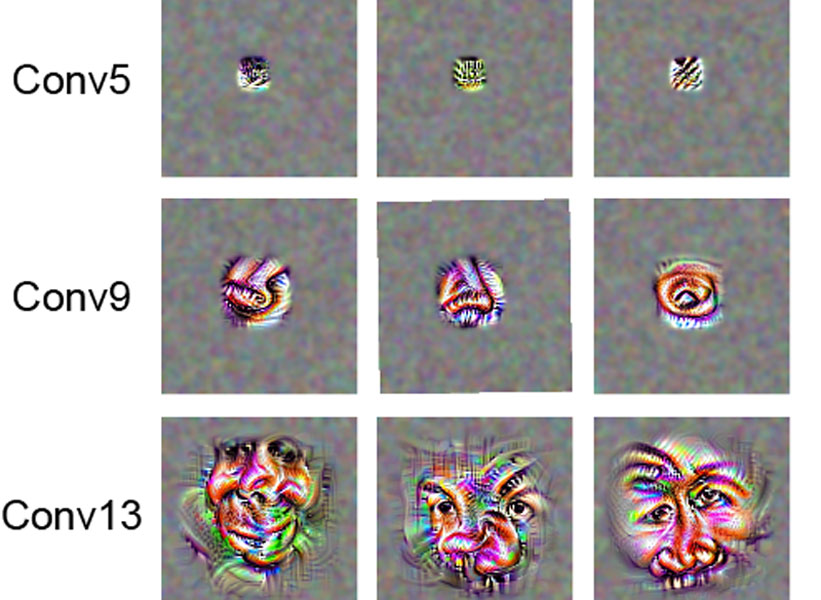
Visualization of the preferred stimulus for example face-ranked filters. While filters in early layers (e.g., Conv5) were maximally activated by simple features, filters responded to features that appear somewhat like face parts (e.g., nose and eyes) in mid-level layers (e.g., Conv9) and appear to represent faces in a more holistic manner in late convolutional layers. Image: Kanwisher lab

As the program learned to identify the objects and faces, it organized itself into an information-processing network with that included units specifically dedicated to face recognition. Like the brain, this specialization occurred during the later stages of image processing. In both the brain and the artificial network, early steps in facial recognition involve more general vision processing machinery, and final stages rely on face-dedicated components.

It’s not known how face-processing machinery arises in a developing brain, but based on their findings, Kanwisher and Dobs say networks don’t necessarily require an innate face-processing mechanism to acquire that specialization. “We didn’t build anything face-ish into our network,” Kanwisher says. “The networks managed to segregate themselves without being given a face-specific nudge.”

Kanwisher says it was thrilling seeing the deep neural network segregate itself into separate parts for face and object recognition. “That’s what we’ve been looking at in the brain for twenty-some years,” she says. “Why do we have a separate system for face recognition in the brain? This tells me it is because that is what an optimized solution looks like.”

Now, she is eager to use deep neural nets to ask similar questions about why other brain functions are organized the way they are. “We have a new way to ask why the brain is organized the way it is,” she says. “How much of the structure we see in human brains will arise spontaneously by training networks to do comparable tasks?”