Tackling rare genetic disorders with patient-focused science
Shannon Knight, a McGovern researcher and BCS PhD candidate, is developing novel gene therapy for childhood-onset epilepsy.
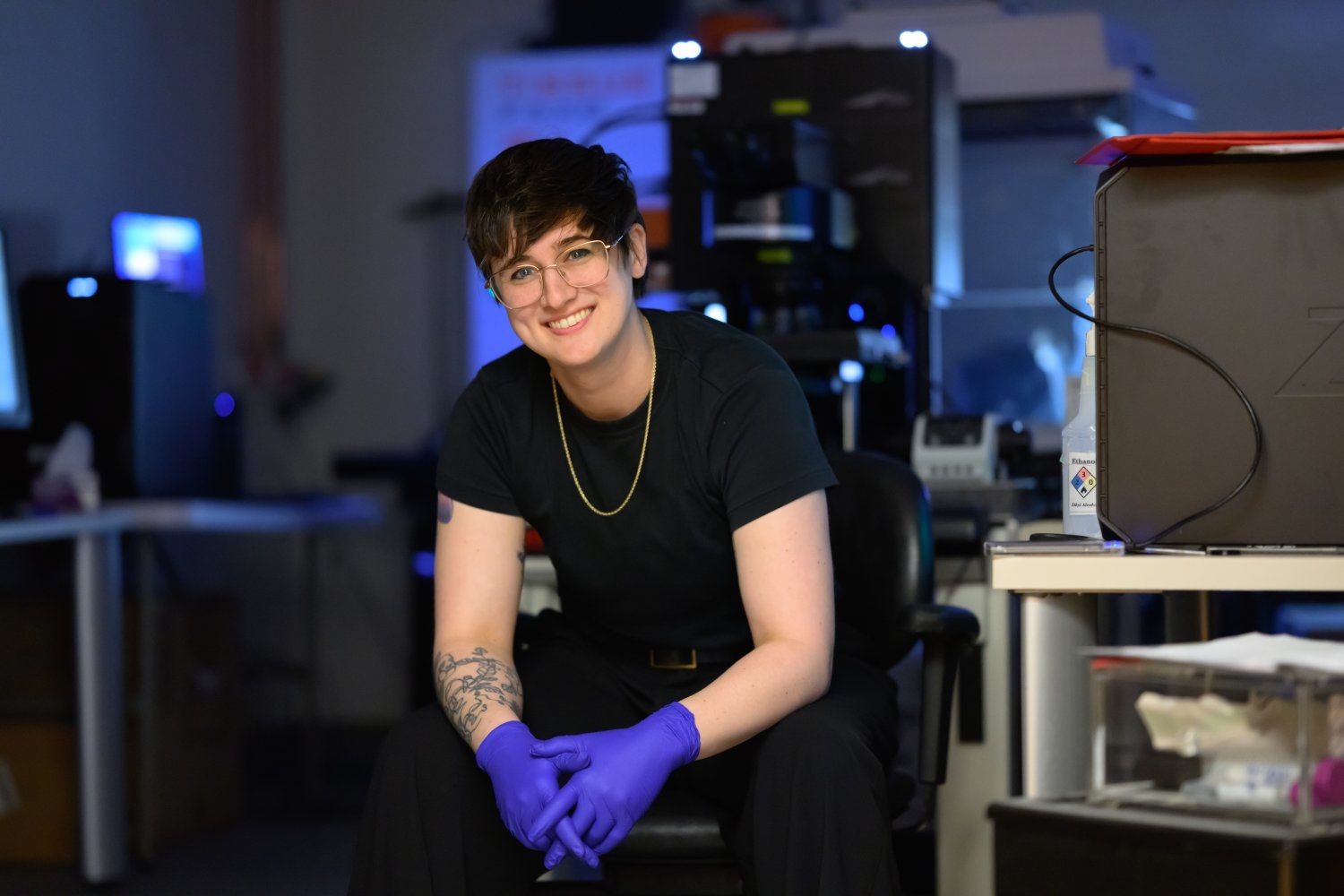
Shannon Knight attributes her interest in neuroscience to an experience she had in high school. She and her sister attended a medical day for students at the nearby University of Illinois Chicago. As they were on their way out of the event, they walked past a room with a person holding a brain.
“We stopped and backpedaled into the room, and I was so fascinated,” says Knight. “I was able to hold the brain of a patient who had passed away of Alzheimer’s. The brain holds so much emotion, decision-making — everything. I realized that this man’s entire memory was in my hands, and something clicked for me. I decided that I really wanted to learn much more about this organ.”
Now in her sixth year of doctoral studies at MIT’s McGovern Institute for Brain Research, Knight is working on developing a novel gene therapy for childhood-onset epilepsy, specifically SYNGAP1 haploinsufficiency. This rare genetic disorder is caused by a mutation in the SYNGAP1 gene, rendering one of the two copies of the gene nonfunctional.
SYNGAP1 is important for brain development and neuronal communication, and the disorder leads to seizures in children starting as young as 4 months old. Other symptoms include intellectual disabilities, challenges with eating and sleeping, and difficulties with movement.
While there are currently methods to address the symptoms of the disorder, such as anti-seizure medications and dietary restrictions, as the child ages, the seizures often become resistant to medications. Knight is working to develop a therapeutic using CRISPR, a biotechnology tool used to edit genes. This therapeutic aims to address the root cause of this medication resistance by focusing on the gene itself.
“The idea of leading science with empathy is something that I feel very deeply,” she says. “I hope my efforts in the lab work toward the benefit of the people affected, rather than just for the benefit of my own science.”
Researching gene therapies
Knight’s interest in the brain flourished as a neuroscience major at Bowdoin College, working with Professor Hadley Horch. While she had originally planned to be pre-med, Knight ultimately decided that it wasn’t the best fit. She enjoyed the research she did as part of her honors thesis, exploring the regeneration of neurons in the auditory system of crickets, and decided that she wanted to pursue more research in molecular neuroscience, as well as genetics.
After graduating, Knight worked at the Perrimon Lab at Harvard University, where she first learned about CRISPR, applying it in a fruit fly model. She worked for two years in the lab, co-authoring a few papers and applying to graduate schools.
She ultimately landed in the lab of MIT Professor Guoping Feng, studying the potential of utilizing CRISPR to develop a gene therapy treatment for Phelan-McDermid Syndrome, a rare genetic disorder caused by a deletion or mutation on the 22nd chromosome.
“Many of our graduate students are passionate about making a positive impact to society through cutting-edge research, and Shannon is a perfect example,” says Feng, the James W. and Patricia T. Poitras Professor and associate director at the McGovern Institute. “She is developing gene therapy technologies that have the potential to help many kids with devastating neurodevelopmental disorders.”
Building off of the gene therapy research around Phelan-McDermid syndrome, which is now in clinical trials in patients, Knight is now in the early phases of testing gene therapy for SYNGAP1 disorder. The goal is to go through the same process for the SYNGAP1 gene therapy as for the Phelan-McDermid gene therapy — eventually obtaining U.S. Food and Drug Administration approval and beginning clinical trials.
The testing of the gene therapy on mice with a version of SYNGAP1 disorder has alleviated seizures and all of the behavioral phenotypes. This promising work is being accelerated by the Rare Brain Disorders Nexus, an MIT initiative that launched in the fall of 2025.
“Something I think about a lot is the idea of who ‘deserves’ the attention of a gene therapy. I feel that, regardless of how rare a genetic disorder might be, it still deserves care,” says Knight. “SYNGAP1 disorder is extremely rare, only impacting one to four out of every 10,000 children. I am very fortunate to be at an institution like MIT that has so many labs and brilliant researchers working on diseases that impact large portions of society, and it was really important to me to spend my PhD years helping a small, often unseen population. Although I don’t actually have a relationship with someone who has SYNGAP1 disorder, I know so many people who feel invisible in systems, and it is really important to me to be able to focus on people who feel unseen and give them hope.”
Inspiring others in the lab
In addition to her passion for neuroscience and genetic research, Knight has also developed a love of teaching. She has been a teaching assistant for class 9.12 (Experimental Molecular Neurobiology), leading the lab portion of the course. She has enjoyed working closely with small classes of students, introducing them to the fundamentals of neuroscience lab research.
“We walked through the process of looking at a specific protein in neurons, and talked about how you can go from cell culture all the way up to a mouse brain — and all the steps in between,” she says. “It was so important to me to be able to teach the students and help them to consider all of the different types of experiments they could do.”
Knight received the Goodwin Medal in 2025 in recognition of her commitment to excellent teaching.
“I’ve talked to many of the students since then,” she says, “and many said it was one of their favorite classes.”