DNA shaper steers nervous system development
A study of worms shows that a protein that helps shape the structure of the genome is critical for establishing the identity of some neurons.

A functional nervous system depends on the cooperation of many kinds of cells. So as developing organisms build their nervous systems, their neurons must take on different forms and functions to fulfill their designated roles. That carefully orchestrated process gives rise to thousands of different cell types in the human brain.
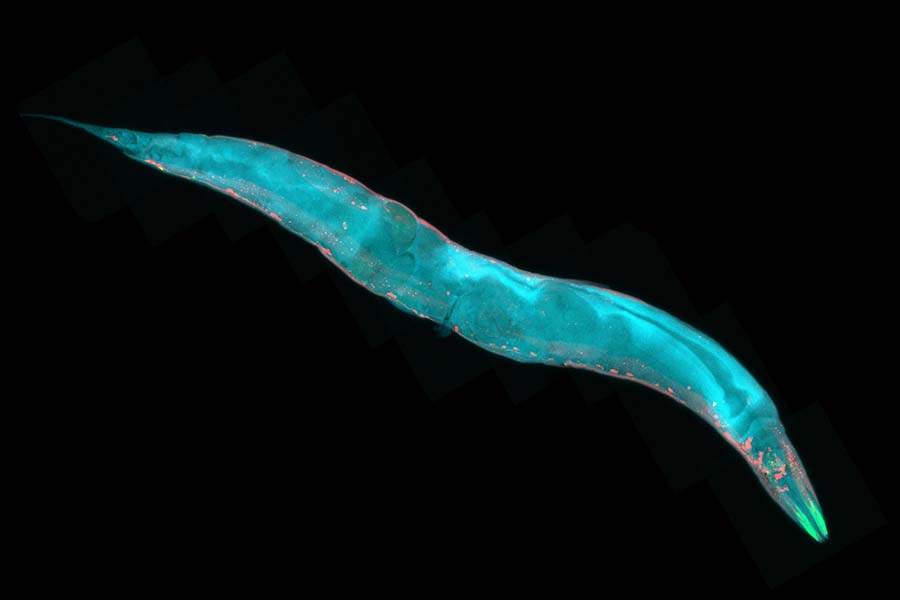
In the tiny worm known as C. elegans, the nervous system is far simpler, comprising a mere 118 classes of neurons.
At MIT, scientists in H. Robert Horvitz’s lab are studying the worms to learn about how nervous systems develop. Horvitz is the David H. Koch Professor of Biology at MIT, an Investigator at the McGovern Institute for Brain Research at MIT, and an Investigator at the Howard Hughes Medical Institute. His team has just discovered that a protein complex called cohesin, which helps shape the three-dimensional structure of the genome in both worms and humans, is critical for establishing some neurons’ identities as development unfolds.
The findings, reported July 31, 2026, in the journal Science Advances, could help scientists find a way to treat a rare developmental disorder called Cornelia de Lange syndrome, which is caused by mutations that interrupt the cohesin complex.
Model organism
Postdoctoral researcher Dongyeop Lee explains that C. elegans is a powerful model for studying neurodevelopment not just because its nervous system has been comprehensively mapped, but also because of the ease and speed with which scientists can study the function of its genes.

Because many of the worm’s genes have been retained through evolution, findings from studies of C. elegans often reveal important aspects of human biology. The current study began with worms that, because of a genetic mutation, make too many neurons of a certain type.
Adrenergic neurons, named for the kind of neurotransmitter they use to communicate with other neurons, are vital for enabling worms to respond to both their environment and their own internal state. Normally, C. elegans has just two pairs of adrenergic neurons: two RIM neurons and two RIC neurons. But the worms Lee studied had extras of both.
Takashi Hirose, a former member of the Horvitz lab, first observed this change in 2007.
Lee later continued the study and discovered that worms carrying a mutation in a gene called coh-1 have extra adrenergic neurons. The coh-1 gene encodes one part of the cohesin complex.
When Lee tested other mutations that disrupt cohesin, he found the same effect: Worms without fully functional cohesin had too many RIM neurons and too many RIC neurons.
Molecular switch
With a series of experiments designed to tease apart how cohesin impacts neurons’ identities, Lee discovered that cohesin cooperates with a gene-regulating protein called EOR-1 (known in humans as PLZF) to direct some neurons to develop into neurons that communicate with the inhibitory neurotransmitter GABA.
By reorganizing the structure of the genome, cohesin can change the way gene regulators like EOR-1 interact with DNA. Lee’s experiments showed that when either cohesin or EOR-1 couldn’t do its job, cells that should have become GABA-producing neurons become adrenergic neurons instead.
“What we found is that there are two alternative possible fates of certain neurons, and cohesin acts as a molecular switch that decides one of the possible neuronal fates,” Lee explains. “This means the structure of genomic DNA in the nucleus is important for neuronal fate determination.”
Disease connection
Lee adds that extra adrenergic neurons were not the only abnormality he observed in worms with cohesin mutations. Cohesin is important for shaping cells and tissues throughout the body. “The mutants have severe developmental defects,” Lee says. “They grow slowly. They don’t move well, and they also have defects in reproduction.”
Notably, the problems Lee saw in the worms echo aspects of Cornelia de Lange syndrome, a rare genetic disorder that impacts physical, cognitive, and behavioral development. Cornelia de Lange syndrome can be caused by mutations in cohesin genes, and Lee says that the discovery of how cohesin mutations affect worm development and behavior opens new opportunities to study the disease and search for potential therapeutic targets in C. elegans.
The Horvitz lab already has some promising leads. Taking advantage of the quick genetic screens that are possible in worms, Lee has found additional mutations that can counteract impaired cohesin, improving the health of worms with cohesin mutations. The team is now working to identify the genes where these suppressor mutations occur, so they can investigate whether they might make good therapeutic targets in humans.
Meanwhile, the team is also exploring a potential role for cohesin in shaping the fates of other neuron types, as well as searching broadly for additional molecules that work with cohesin to guide development. “We expect we have opened up a new biology,” Lee says. “This paper is just the beginning.”