An unexpected player in the response to low oxygen
To cope with low levels of oxygen, cells call on a quality-control system for RNA.
Oxygen is crucial for powering our cells, so when its levels dip, the body is quick to respond. Animals from worms to humans have a dedicated system for sensing when oxygen is low and taking steps to protect themselves. That response kicks in in low-oxygen environments, like we encounter at high altitudes, or when cells lose access to oxygen because of medical conditions, such as stroke or cancer (because solid tumors can lose access to the oxygenated blood supply). It’s also essential for healthy development.
McGovern investigator H. Robert Horvitz has been studying cells’ response to low oxygen—a condition known as hypoxia—for decades. Now, his lab has linked the hypoxia response to another vital cellular process known as nonsense mediated decay (NMD), which protects cells by destroying certain faulty or unwanted RNA molecules. In studies of worms, postdoctoral researcher Calista Diehl found that NMD is essential for aspects of the animals’ response to low oxygen. The findings were reported October 28, 2026, in the journal Science Advances.
Shared molecular pathway
Diehl explains that key players in the molecular pathway that cells use to respond to hypoxia, including an oxygen sensor called EGL-9 that Horvitz’s team discovered in the 1980s and a gene-expression regulator called HIF-1, are shared by almost all animals, including humans. Cells use the EGL-9-HIF-1 pathway to adjust their gene activity to shift their metabolism and conserve energy when oxygen is low. Drug developers hope that by manipulating the hypoxia response pathway, they may find new treatments for cancer, stroke, and other disorders.
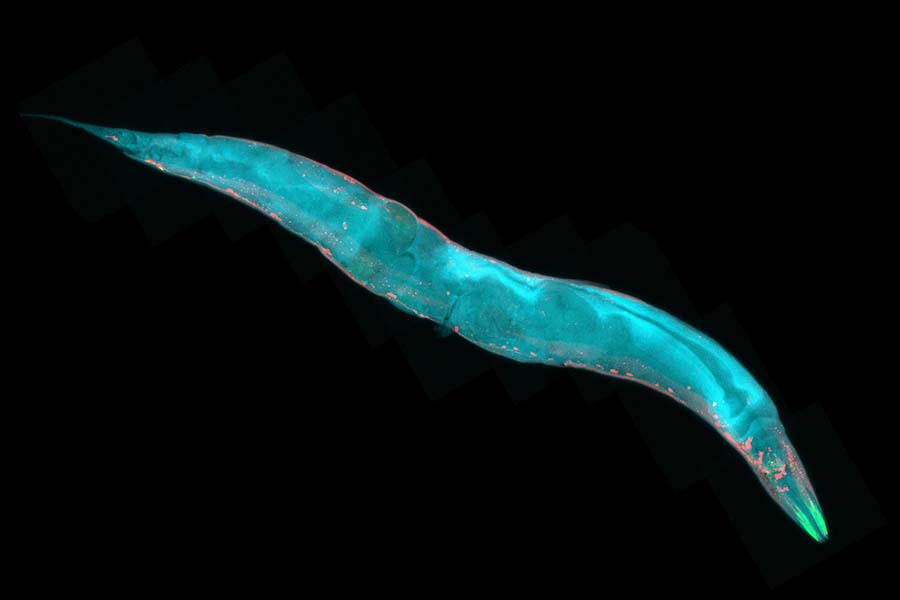
In the worms that the Horvitz lab studies, known as Caenorhabditis elegans, one clear sign of the hypoxia response is a change in egg-laying behavior. In fact, the hypoxia-response pathway first caught the attention of the Horvitz lab because when worms are missing EGL-9, they retaining their eggs in their uterus for a prolonged period, which later work revealed is because the absence of EGL-9 makes worms behave as if they are lacking oxygen.
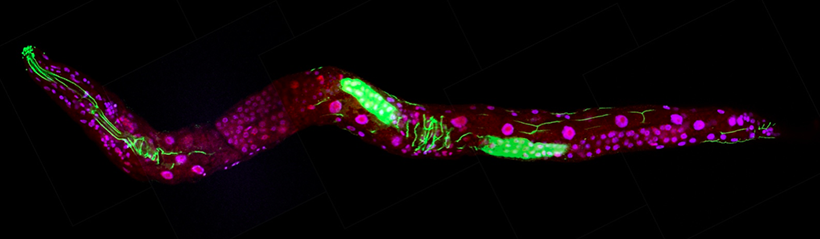
“It makes sense that worms delay egg laying when there’s not enough oxygen, since embryos that emerge in those conditions are unlikely to survive,” Diehl explains. But it wasn’t clear how worms orchestrated this behavioral change. Diehl wanted to know more, so she searched for other genes that might be involved in the hypoxia response.
To find them, she introduced random mutations into worms in which the hypoxia response pathway was already disrupted because of mutations in two genes, egl-9 and cyp-36A1, which the Horvitz lab had previously shown to function in response to the EGL-9-HIF-1 pathway. She was looking for any new mutations that reversed the impact of egl-9 mutations. That screen led her to a gene involved in NMD, called smg-1.
smg-1 is one of seven genes that worms need to carry out NMD. Diehl tested the others, too. With every one she saw the same thing. She concluded that without NMD, worms couldn’t respond to hypoxia like they usually do, showing that NMD functions with the EGL-9-HIF-1 pathway in the hypoxia response.
When Diehl looked deeper into what happens when worms without NMD encounter low oxygen, she was surprised to discover that while some aspects of the hypoxia response—like the change to egg-laying behavior and a reduction in defecation— were eliminated, other hypoxia-induced changes—like a slowing of locomotion and increased resistance to certain kinds of cellular stress—did not require NMD. “NMD affected some but not all behaviors, and some but not all stress responses,” Diehl says. “When both pathways are intact, those changes always occur together.”
A survey of gene activity hinted that NMD and the hypoxia-response pathways might cooperate to adjust the activity of a specific subset of genes when oxygen is low. When Diehl looked for genes with activity that is altered by both NMD and the hypoxia-response regulator HIF-1, two categories were particularly well represented on the list: genes involved in metabolism and pseudogenes, which are gene-like sequences that have lost their function through evolution and are not usually used to produce proteins.
Diehl points out possible medical implications of NMD’s intersection with the hypoxia response, positing that individuals with genetic changes that interfere with NMD might be more sensitive to hypoxic stress or hypoxia responses. She points to neurodevelopmental disorders as an example of conditions known to be affected by both hypoxia and NMD: Perinatal hypoxia—when a baby receives too little oxygen around the time of birth—increases the risk of many neurodevelopmental disorders, as do variations in NMD-related genes.