Sound intuition
A rich intuition for the way sound works lets people infer what kinds of objects created the noises they hear.
When you hear an unexpected thump from another room, you may have a good idea of what’s happened, even without looking. A ball bounced against the wall sounds different than a plate falling to the floor, and it’s not hard to tell which is which. You can probably even guess at the size of the ball.
That’s because our brains have a surprisingly sophisticated understanding of how objects make sounds. Scientists at MIT’s McGovern Institute say that comes from an internal awareness of the acoustic regularities of the world.
In a study reported November 6, 2026, in the journal PNAS, researchers led by McGovern investigator Josh McDermott showed that people don’t just associate specific properties of a sound, like pitch or duration, with individual physical properties, like size or material. Instead, they use their knowledge of the world to tease out how a single sound may be shaped by multiple physical variables.
The physics of sound
There is a direct relationship between an object’s physical properties and the sounds it makes.
When a dropped object hits the floor, the heavier it is, the lower the frequencies of the resulting sound are likely to be. And when you tap on a glass with a spoon, the sound will ring for longer than it would if you tapped on a plastic cup, because sound waves vibrate longer within a stiff material.
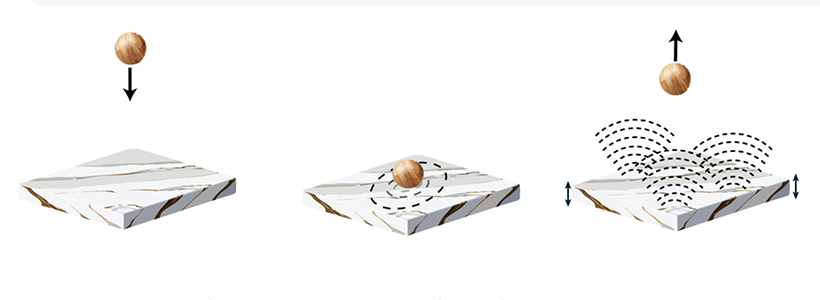
But identifying the unseen cause of an impact sound is a complicated problem. When two objects come together, the sound they make depends on the shape, size, and stiffness of both of them. So if you hear a clink or a crash and you don’t know anything about what made the noise, how can you estimate the physical properties of the objects involved? “The only way, in principle, I think that people could do that is if they know something about the way that the actual sounds in the world are generated,” McDermott says.
A sonic experiment
McDermott and his team, including former Yang Computational Neuroscience Fellow in the K. Lisa Yang ICoN Center Vinayak Agarwal and former postdoctoral researcher James Traer, who are first authors of the PNAS paper, suspected that people have internalized statistics about the worlds’ sounds and use these to interpret the noises that they hear. To test that idea, they asked people to listen to simulated collisions where sounds behaved as they do in the natural world, and also to collisions where sounds behaved abnormally.
To create those sounds, they first needed to collect data on object acoustics. While multiple factors determine the sound of an impact, those sounds can be predicted using two measurements: the force of the impact and each object’s impulse response—a measure of how the object vibrates after receiving a brief force, or impulse. To generate realistic impact sounds, the team needed to know the impulse responses of everyday objects.
To be sure they were focusing on the kinds of objects that people are accustomed to hearing collide, the researchers sent out surveys asking people about the things they had recently heard being dropped, struck, tapped, or scraped. Based on the responses, they selected more than 400 objects, then measured their impulse responses. For each one, they attached small speakers and microphones directly to the object surface. A contact speaker sent vibrations into the object, and microphones recorded those vibrations at different points.
With those measurements in hand, the team analyzed how impulse responses varied with size and material. They used that information to create new impact sounds.
Using impulse responses that fit within the natural distributions that had measured, they simulated the sounds of various collisions, and gave listeners two tasks. In the first, they listened to two falling balls. The researchers asked them to decide which was heavier, based on the sounds they made when they hit the surface below. Even though the two balls fell onto different surfaces (such as plastic and ceramic—although listeners did not know this), study participants were usually able to pick out which sound came from the heavier ball.
In the second task, listeners were asked whether an object they heard being struck was sitting on a table or being held in someone’s hands. Study participants were good at this too. “When you hold an object, your hand absorbs a lot of the sound energy, so the sound doesn’t reverberate around in the object for as long, and you can hear that,” Agarwal explains. Listeners were usually able to pick up on this, even without knowing what sort of material was being struck, which also matters for how long sound energy persists.
Breaking the rules
When the researchers manipulated the sounds, however, shifting the measures for objects’ impulse responses outside the natural distribution, participants struggled with both tasks. “When we draw them from these alternative distributions that are less like the world, people are much worse at doing this task,” Agarwal explains.
“It’s clear that people are able to do this to the extent that the sounds kind of obey the statistics of the world, which suggests that we have learned those statistics over our lives,” McDermott explains. Much of that learning likely happens early in life, he says, recalling how his children loved to bang objects together when they were young, exposing their developing brains to plenty of input about how sounds work.
McDermott says the work adds to a growing understanding of people’s internal awareness of the physics of the world. With their large dataset of acoustic measurements for everyday objects, which simplifies the generation of sounds for future experiments, the team plans to explore how people use more complex sounds to understand events, such as what they infer when they hear an object bounce or roll, as well as how auditory information is integrated with visual cues.