The brain’s internal ruler
A simple brain circuit measures objects’ distance from the body using touch signals from a rodent’s whiskers.

If you are crossing an unfamiliar room in the dark, you may grope around a bit to get a sense of your space.
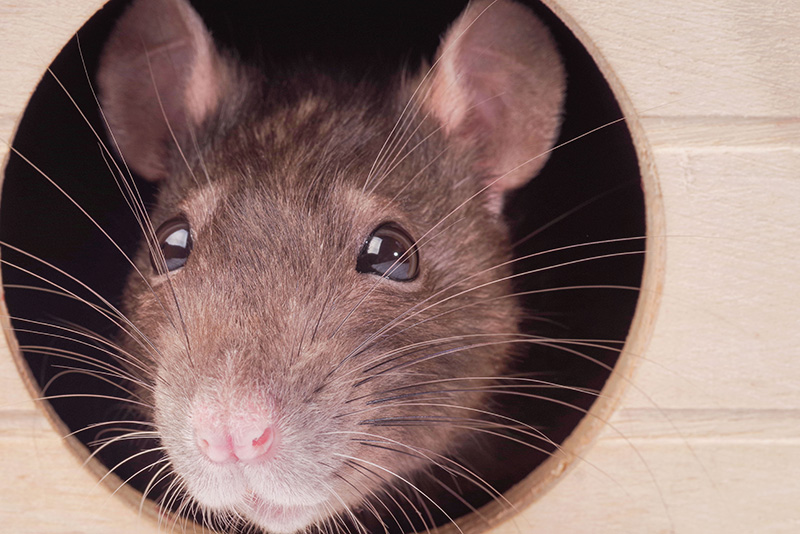
But for many animals, feeling out a space comes more naturally. A mouse, for instance, can efficiently navigate in the dark just by grazing its whiskers against walls and other obstacles.
Fan Wang, a professor of brain and cognitive sciences and an investigator at the McGovern Institute, has discovered how neurons in a mouse’s brainstem use signals from the animal’s touch-sensitive whiskers to estimate an object’s distance from the face.
Her team’s findings, published online June 25, 2026, in the journal Neuron, unlock key circuitry the brain uses to represent the space immediately surrounding the body.
Mapping space
The circuit the team discovered is part of the brain’s system for creating an egocentric map of space—that is, understanding where things are relative to one’s own body. Neuroscientists know that the brain calls on specialized circuits to understand space in this way, which are different from its system for mapping space using external landmarks.
In their study, Wang and her team explored how the brain maps the space closest to the body, which is known as the peripersonal space. This is the space in which we move, and it is vital that we understand where things are in relationship to our bodies so we can reach, step, avoid hazards, and otherwise interact effectively with our environment.
Wang says mice were an appealing model for investigating how the brain understands objects’ distance within the peripersonal space, because a rodent’s whiskers seem so much like a built-in set of rulers. These whiskers, which vary in length, are swept back and forth as the animals explore their environment. As whiskers bend and vibrate, the mechanical sensations are relayed to the brain by sensory neurons at their base. Those neurons fire more when a whisker bends close to the face than they do in response to contact near the whisker’s tip, communicating information about the proximity of the touch.
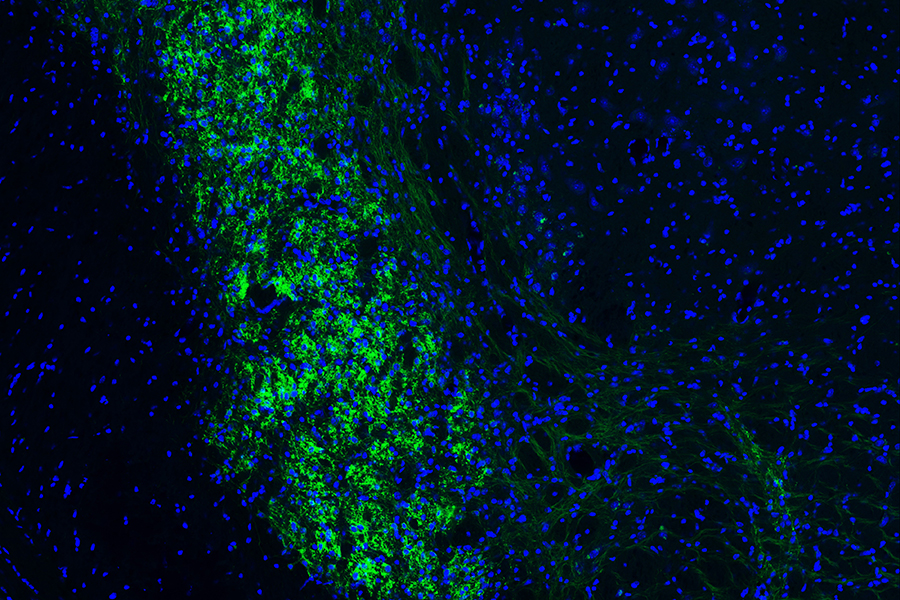
Wang’s team wanted to know if the brain uses these signals to build an internal ruler-like representation of distance more precise than “near” or “far.” To find out, graduate student Wenxi Xiao and research scientist Kyle Severson monitored neural activity in a small sensory-processing region in the brainstem where tactile signals from the whiskers first arrive in the brain. They studied what happened there as mice walked on a treadmill while brushing their whiskers against a wall that passed by at different distances.
Many neurons in the region were sensitive to the whisker bending triggered by the wall. Some behaved similarly to the sensory neurons they were getting their information from, firing more when the wall was closer to the face and thus serving as a proximity-based distance code. But other cells were tuned in to discrete distances, firing only when the distance of the wall the whiskers had touched was within a specific range.
For some neurons, activity peaked when the wall was 23 mm away from the face, near the tips of the longest whiskers. Others responded most when the wall was at intermediate distances.
“Each of these neurons represents a specific distance, and together they span the full range reached by the longest whisker, like tick marks on the ruler,” Wang explains. “We call that the map code.”
The team wanted to know how the brain converts proximity signals from different whiskers into accurate map code of object’s distances from the head. “You cannot just listen to individual whisker neurons, because a contact at the tip of a short whisker would be in the middle of a long whisker. You need a brain circuit to build a unified distance map,” Wang says.
Through computational modeling and by exploring what happened when they manipulated neural signaling in specific ways, Wang’s team showed how distances can be calculated by comparing inputs from different sensory neurons. Their findings suggest that each brainstem neuron that makes up the map code receives both direct excitatory inputs from proximity-sensitive whisker neurons and inhibitory inputs from neurons driven by proximity-dependent whisker touch signals.
“Essentially the inhibitory pathway allows the brainstem to compare two inputs by subtraction,” Wang explains. “If one input signals ‘this is how far it is’ and the other signals ‘this is how far I estimate it to be,’ subtracting one from the other yields an intermediate value. We think it’s a simple and elegant way to transform tactile input into a representation of discrete distance.”
Wang notes that despite their importance, the brain’s body-centered representations of space have so far received little attention from neuroscientists, who know much more about how we understand locations in space relative to landmarks (an allocentric map). She is eager to investigate how the egocentric map code her team discovered is integrated with other brain systems to guide movement, social interactions, and other behavior, and hopes the findings will further exploration from other groups.
The study was funded by grants from the National Institutes of Health.