MIT faculty share their creative and technical talent on campus as well as across the globe, compounding the Institute’s impact through strong international partnerships. Thanks to the MIT Global Seed Funds (GSF) program, managed by the MIT International Science and Technology Initiatives (MISTI), more of these faculty members will be able to build on these relationships to develop ideas and create new projects.
“This MISTI fund was extremely helpful in consolidating our collaboration and has been the start of a long-term interaction between the two teams,” says 2017 GSF awardee Mehrdad Jazayeri, associate professor of brain and cognitive sciences and investigator at the McGovern Institute for Brain Research. “We have already submitted multiple abstracts to conferences together, mapped out several ongoing projects, and secured international funding thanks to the preliminary progress this seed fund enabled.”
This year, the 28 funds that comprise MISTI GSF received 232 MIT applications. Over $2.3 million was awarded to 107 projects from 23 departments across the entire Institute. This brings the amount awarded to $22 million over the 12-year life of the program. Besides supporting faculty, these funds also provide meaningful educational opportunities for students. The majority of GSF teams include students from MIT and international collaborators, bolstering both their research portfolios and global experience.
“This project has had important impact on my grad student’s education and development. She was able to apply techniques she has learned to a new and challenging system, mentor an international student, participate in a major international meeting, and visit CEA,” says Professor of Chemistry Elizabeth Nolan, a 2017 GSF awardee.
On top of these academic and research goals, students are actively broadening their cultural experience and scope. “The environment at CEA differs enormously from MIT because it is a national lab and because lab structure and graduate education in France is markedly different than at MIT,” Nolan continues. “At CEA, she had the opportunity to present research to distinguished international colleagues.”
These impactful partnerships unite faculty teams behind common goals to tackle worldwide challenges, helping to develop solutions that would not be possible without international collaboration. 2017 GSF winner Emilio Bizzi, professor emeritus of brain and cognitive sciences and emeritus investigator at the McGovern Institute, articulated the advantage of combining these individual skills within a high-level team. “The collaboration among researchers was valuable in sharing knowledge, experience, skills and techniques … as well as offering the probability of future development of systems to aid in rehabilitation of patients suffering TBI.”
The research opportunities that grow from these seed funds often lead to published papers and additional funding leveraged from early results. The next call for proposals will be in mid-May.
MISTI creates applied international learning opportunities for MIT students that increase their ability to understand and address real-world problems. MISTI collaborates with partners at MIT and beyond, serving as a vital nexus of international activity and bolstering the Institute’s research mission by promoting collaborations between MIT faculty members and their counterparts abroad.
Many people with autism spectrum disorders are highly sensitive to light, noise, and other sensory input. A new study in mice reveals a neural circuit that appears to underlie this hypersensitivity, offering a possible strategy for developing new treatments.
MIT and Brown University neuroscientists found that mice lacking a protein called Shank3, which has been previously linked with autism, were more sensitive to a touch on their whiskers than genetically normal mice. These Shank3-deficient mice also had overactive excitatory neurons in a region of the brain called the somatosensory cortex, which the researchers believe accounts for their over-reactivity.
There are currently no treatments for sensory hypersensitivity, but the researchers believe that uncovering the cellular basis of this sensitivity may help scientists to develop potential treatments.
“We hope our studies can point us to the right direction for the next generation of treatment development,” says Guoping Feng, the James W. and Patricia Poitras Professor of Neuroscience at MIT and a member of MIT’s McGovern Institute for Brain Research.
Feng and Christopher Moore, a professor of neuroscience at Brown University, are the senior authors of the paper, which appears today in Nature Neuroscience. McGovern Institute research scientist Qian Chen and Brown postdoc Christopher Deister are the lead authors of the study.
Too much excitation
The Shank3 protein is important for the function of synapses — connections that allow neurons to communicate with each other. Feng has previously shown that mice lacking the Shank3 gene display many traits associated with autism, including avoidance of social interaction, and compulsive, repetitive behavior.
In the new study, Feng and his colleagues set out to study whether these mice also show sensory hypersensitivity. For mice, one of the most important sources of sensory input is the whiskers, which help them to navigate and to maintain their balance, among other functions.
The researchers developed a way to measure the mice’s sensitivity to slight deflections of their whiskers, and then trained the mutant Shank3 mice and normal (“wild-type”) mice to display behaviors that signaled when they felt a touch to their whiskers. They found that mice that were missing Shank3 accurately reported very slight deflections that were not noticed by the normal mice.
“They are very sensitive to weak sensory input, which barely can be detected by wild-type mice,” Feng says. “That is a direct indication that they have sensory over-reactivity.”
Once they had established that the mutant mice experienced sensory hypersensitivity, the researchers set out to analyze the underlying neural activity. To do that, they used an imaging technique that can measure calcium levels, which indicate neural activity, in specific cell types.
They found that when the mice’s whiskers were touched, excitatory neurons in the somatosensory cortex were overactive. This was somewhat surprising because when Shank3 is missing, synaptic activity should drop. That led the researchers to hypothesize that the root of the problem was low levels of Shank3 in the inhibitory neurons that normally turn down the activity of excitatory neurons. Under that hypothesis, diminishing those inhibitory neurons’ activity would allow excitatory neurons to go unchecked, leading to sensory hypersensitivity.
To test this idea, the researchers genetically engineered mice so that they could turn off Shank3 expression exclusively in inhibitory neurons of the somatosensory cortex. As they had suspected, they found that in these mice, excitatory neurons were overactive, even though those neurons had normal levels of Shank3.
“If you only delete Shank3 in the inhibitory neurons in the somatosensory cortex, and the rest of the brain and the body is normal, you see a similar phenomenon where you have hyperactive excitatory neurons and increased sensory sensitivity in these mice,” Feng says.
Reversing hypersensitivity
The results suggest that reestablishing normal levels of neuron activity could reverse this kind of hypersensitivity, Feng says.
“That gives us a cellular target for how in the future we could potentially modulate the inhibitory neuron activity level, which might be beneficial to correct this sensory abnormality,” he says.
Many other studies in mice have linked defects in inhibitory neurons to neurological disorders, including Fragile X syndrome and Rett syndrome, as well as autism.
“Our study is one of several that provide a direct and causative link between inhibitory defects and sensory abnormality, in this model at least,” Feng says. “It provides further evidence to support inhibitory neuron defects as one of the key mechanisms in models of autism spectrum disorders.”
He now plans to study the timing of when these impairments arise during an animal’s development, which could help to guide the development of possible treatments. There are existing drugs that can turn down excitatory neurons, but these drugs have a sedative effect if used throughout the brain, so more targeted treatments could be a better option, Feng says.
“We don’t have a clear target yet, but we have a clear cellular phenomenon to help guide us,” he says. “We are still far away from developing a treatment, but we’re happy that we have identified defects that point in which direction we should go.”
When your mother calls your name, you know it’s her voice — no matter the volume, even over a poor cell phone connection. And when you see her face, you know it’s hers — if she is far away, if the lighting is poor, or if you are on a bad FaceTime call. This robustness to variation is a hallmark of human perception. On the other hand, we are susceptible to illusions: We might fail to distinguish between sounds or images that are, in fact, different. Scientists have explained many of these illusions, but we lack a full understanding of the invariances in our auditory and visual systems.
Deep neural networks also have performed speech recognition and image classification tasks with impressive robustness to variations in the auditory or visual stimuli. But are the invariances learned by these models similar to the invariances learned by human perceptual systems? A group of MIT researchers has discovered that they are different. They presented their findings yesterday at the 2019 Conference on Neural Information Processing Systems.
The researchers made a novel generalization of a classical concept: “metamers” — physically distinct stimuli that generate the same perceptual effect. The most famous examples of metamer stimuli arise because most people have three different types of cones in their retinae, which are responsible for color vision. The perceived color of any single wavelength of light can be matched exactly by a particular combination of three lights of different colors — for example, red, green, and blue lights. Nineteenth-century scientists inferred from this observation that humans have three different types of bright-light detectors in our eyes. This is the basis for electronic color displays on all of the screens we stare at every day. Another example in the visual system is that when we fix our gaze on an object, we may perceive surrounding visual scenes that differ at the periphery as identical. In the auditory domain, something analogous can be observed. For example, the “textural” sound of two swarms of insects might be indistinguishable, despite differing in the acoustic details that compose them, because they have similar aggregate statistical properties. In each case, the metamers provide insight into the mechanisms of perception, and constrain models of the human visual or auditory systems.
In the current work, the researchers randomly chose natural images and sound clips of spoken words from standard databases, and then synthesized sounds and images so that deep neural networks would sort them into the same classes as their natural counterparts. That is, they generated physically distinct stimuli that are classified identically by models, rather than by humans. This is a new way to think about metamers, generalizing the concept to swap the role of computer models for human perceivers. They therefore called these synthesized stimuli “model metamers” of the paired natural stimuli. The researchers then tested whether humans could identify the words and images.
“Participants heard a short segment of speech and had to identify from a list of words which word was in the middle of the clip. For the natural audio this task is easy, but for many of the model metamers humans had a hard time recognizing the sound,” explains first-author Jenelle Feather, a graduate student in the MIT Department of Brain and Cognitive Sciences (BCS) and a member of the Center for Brains, Minds, and Machines (CBMM). That is, humans would not put the synthetic stimuli in the same class as the spoken word “bird” or the image of a bird. In fact, model metamers generated to match the responses of the deepest layers of the model were generally unrecognizable as words or images by human subjects.
Josh McDermott, associate professor in BCS and investigator in CBMM, makes the following case: “The basic logic is that if we have a good model of human perception, say of speech recognition, then if we pick two sounds that the model says are the same and present these two sounds to a human listener, that human should also say that the two sounds are the same. If the human listener instead perceives the stimuli to be different, this is a clear indication that the representations in our model do not match those of human perception.”
Joining Feather and McDermott on the paper are Alex Durango, a post-baccalaureate student, and Ray Gonzalez, a research assistant, both in BCS.
There is another type of failure of deep networks that has received a lot of attention in the media: adversarial examples (see, for example, “Why did my classifier just mistake a turtle for a rifle?“). These are stimuli that appear similar to humans but are misclassified by a model network (by design — they are constructed to be misclassified). They are complementary to the stimuli generated by Feather’s group, which sound or appear different to humans but are designed to be co-classified by the model network. The vulnerabilities of model networks exposed to adversarial attacks are well-known — face-recognition software might mistake identities; automated vehicles might not recognize pedestrians.
The importance of this work lies in improving models of perception beyond deep networks. Although the standard adversarial examples indicate differences between deep networks and human perceptual systems, the new stimuli generated by the McDermott group arguably represent a more fundamental model failure — they show that generic examples of stimuli classified as the same by a deep network produce wildly different percepts for humans.
The team also figured out ways to modify the model networks to yield metamers that were more plausible sounds and images to humans. As McDermott says, “This gives us hope that we may be able to eventually develop models that pass the metamer test and better capture human invariances.”
“Model metamers demonstrate a significant failure of present-day neural networks to match the invariances in the human visual and auditory systems,” says Feather, “We hope that this work will provide a useful behavioral measuring stick to improve model representations and create better models of human sensory systems.”
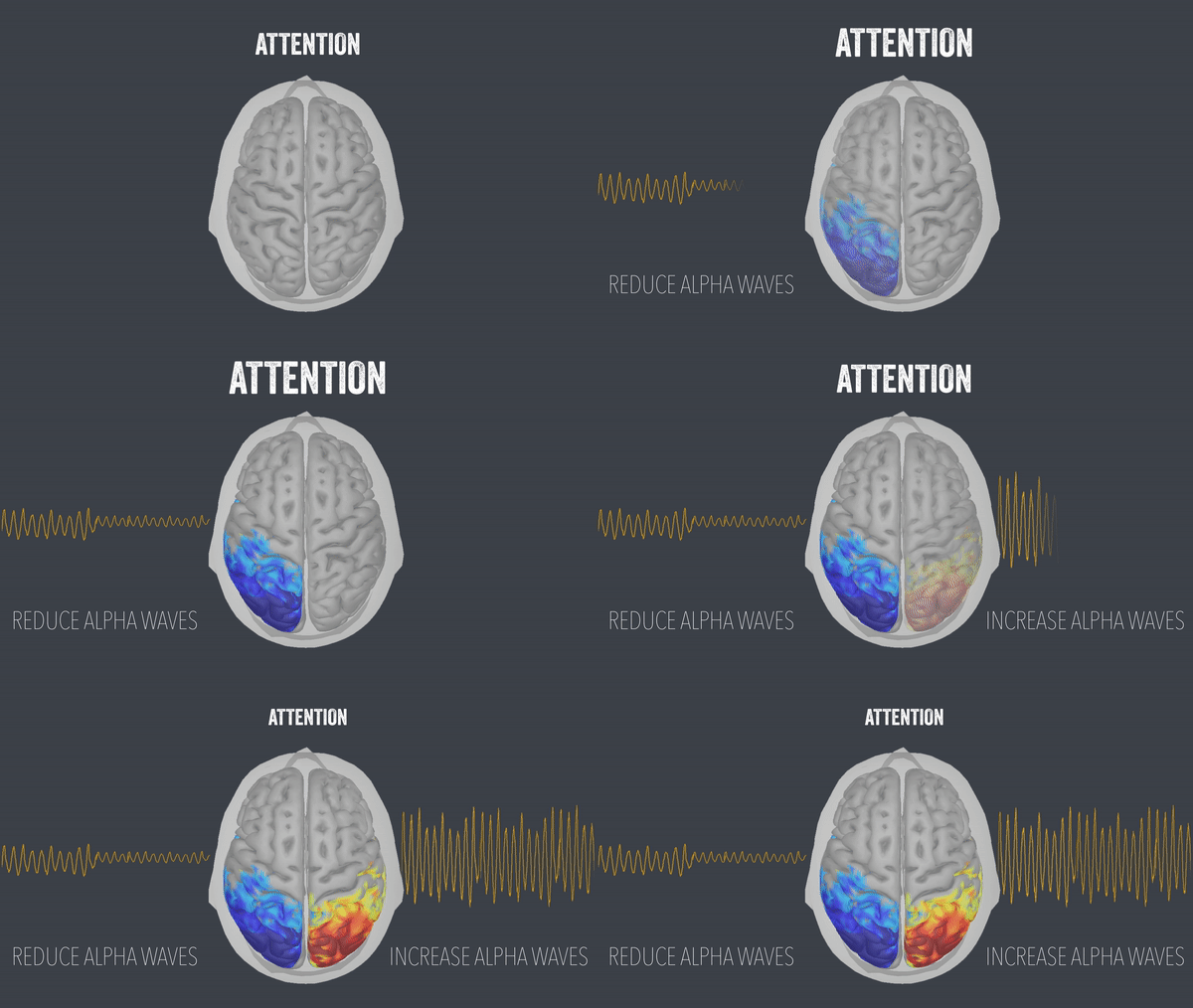
Having trouble paying attention? MIT neuroscientists may have a solution for you: Turn down your alpha brain waves. In a new study, the researchers found that people can enhance their attention by controlling their own alpha brain waves based on neurofeedback they receive as they perform a particular task.
The study found that when subjects learned to suppress alpha waves in one hemisphere of their parietal cortex, they were able to pay better attention to objects that appeared on the opposite side of their visual field. This is the first time that this cause-and-effect relationship has been seen, and it suggests that it may be possible for people to learn to improve their attention through neurofeedback.
Desimone lab study shows that people can boost attention by manipulating their own alpha brain waves with neurofeedback training.
“There’s a lot of interest in using neurofeedback to try to help people with various brain disorders and behavioral problems,” says Robert Desimone, director of MIT’s McGovern Institute for Brain Research. “It’s a completely noninvasive way of controlling and testing the role of different types of brain activity.”
It’s unknown how long these effects might last and whether this kind of control could be achieved with other types of brain waves, such as beta waves, which are linked to Parkinson’s disease. The researchers are now planning additional studies of whether this type of neurofeedback training might help people suffering from attentional or other neurological disorders.
Desimone is the senior author of the paper, which appears in Neuron on Dec. 4. McGovern Institute postdoc Yasaman Bagherzadeh is the lead author of the study. Daniel Baldauf, a former McGovern Institute research scientist, and Dimitrios Pantazis, a McGovern Institute principal research scientist, are also authors of the paper.
Alpha and attention
There are billions of neurons in the brain, and their combined electrical signals generate oscillations known as brain waves. Alpha waves, which oscillate in the frequency of 8 to 12 hertz, are believed to play a role in filtering out distracting sensory information.
Previous studies have shown a strong correlation between attention and alpha brain waves, particularly in the parietal cortex. In humans and in animal studies, a decrease in alpha waves has been linked to enhanced attention. However, it was unclear if alpha waves control attention or are just a byproduct of some other process that governs attention, Desimone says.
To test whether alpha waves actually regulate attention, the researchers designed an experiment in which people were given real-time feedback on their alpha waves as they performed a task. Subjects were asked to look at a grating pattern in the center of a screen, and told to use mental effort to increase the contrast of the pattern as they looked at it, making it more visible.
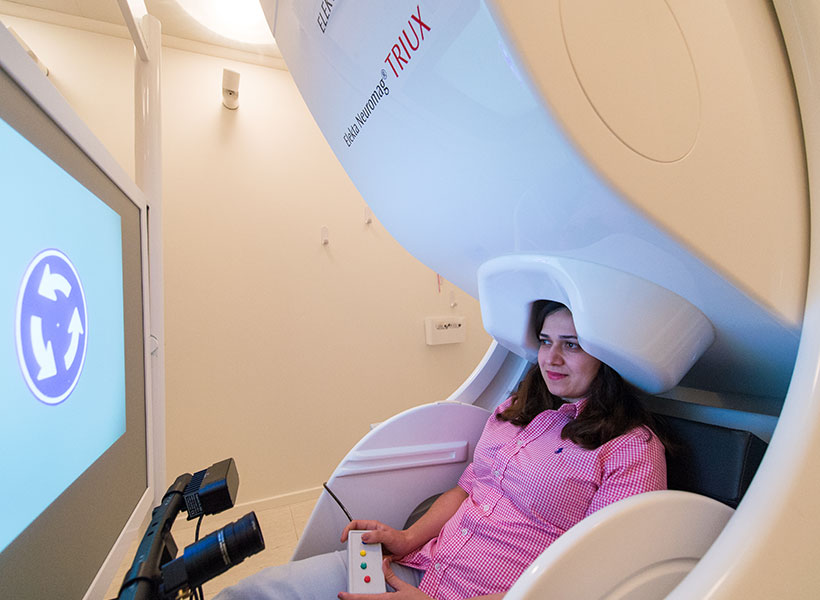
During the task, subjects were scanned using magnetoencephalography (MEG), which reveals brain activity with millisecond precision. The researchers measured alpha levels in both the left and right hemispheres of the parietal cortex and calculated the degree of asymmetry between the two levels. As the asymmetry between the two hemispheres grew, the grating pattern became more visible, offering the participants real-time feedback.
McGovern postdoc Yasaman sits in a magnetoencephalography (MEG) scanner. Photo: Justin Knight
Although subjects were not told anything about what was happening, after about 20 trials (which took about 10 minutes), they were able to increase the contrast of the pattern. The MEG results indicated they had done so by controlling the asymmetry of their alpha waves.
“After the experiment, the subjects said they knew that they were controlling the contrast, but they didn’t know how they did it,” Bagherzadeh says. “We think the basis is conditional learning — whenever you do a behavior and you receive a reward, you’re reinforcing that behavior. People usually don’t have any feedback on their brain activity, but when we provide it to them and reward them, they learn by practicing.”
Although the subjects were not consciously aware of how they were manipulating their brain waves, they were able to do it, and this success translated into enhanced attention on the opposite side of the visual field. As the subjects looked at the pattern in the center of the screen, the researchers flashed dots of light on either side of the screen. The participants had been told to ignore these flashes, but the researchers measured how their visual cortex responded to them.
One group of participants was trained to suppress alpha waves in the left side of the brain, while the other was trained to suppress the right side. In those who had reduced alpha on the left side, their visual cortex showed a larger response to flashes of light on the right side of the screen, while those with reduced alpha on the right side responded more to flashes seen on the left side.
“Alpha manipulation really was controlling people’s attention, even though they didn’t have any clear understanding of how they were doing it,” Desimone says.
Persistent effect
After the neurofeedback training session ended, the researchers asked subjects to perform two additional tasks that involve attention, and found that the enhanced attention persisted. In one experiment, subjects were asked to watch for a grating pattern, similar to what they had seen during the neurofeedback task, to appear. In some of the trials, they were told in advance to pay attention to one side of the visual field, but in others, they were not given any direction.
When the subjects were told to pay attention to one side, that instruction was the dominant factor in where they looked. But if they were not given any cue in advance, they tended to pay more attention to the side that had been favored during their neurofeedback training.
In another task, participants were asked to look at an image such as a natural outdoor scene, urban scene, or computer-generated fractal shape. By tracking subjects’ eye movements, the researchers found that people spent more time looking at the side that their alpha waves had trained them to pay attention to.
“It is promising that the effects did seem to persist afterwards,” says Desimone, though more study is needed to determine how long these effects might last.
The research was funded by the McGovern Institute.
The School of Science has announced that 14 of its faculty members have been appointed to named professorships. The faculty members selected for these positions receive additional support to pursue their research and develop their careers.
Riccardo Comin is an assistant professor in the Department of Physics. He has been named a Class of 1947 Career Development Professor. This three-year professorship is granted in recognition of the recipient’s outstanding work in both research and teaching. Comin is interested in condensed matter physics. He uses experimental methods to synthesize new materials, as well as analysis through spectroscopy and scattering to investigate solid state physics. Specifically, the Comin lab attempts to discover and characterize electronic phases of quantum materials. Recently, his lab, in collaboration with colleagues, discovered that weaving a conductive material into a particular pattern known as the “kagome” pattern can result in quantum behavior when electricity is passed through.
Joseph Davis, assistant professor in the Department of Biology, has been named a Whitehead Career Development Professor. He looks at how cells build and deconstruct complex molecular machinery. The work of his lab group relies on biochemistry, biophysics, and structural approaches that include spectrometry and microscopy. A current project investigates the formation of the ribosome, an essential component in all cells. His work has implications for metabolic engineering, drug delivery, and materials science.
Lawrence Guth is now the Claude E. Shannon (1940) Professor of Mathematics. Guth explores harmonic analysis and combinatorics, and he is also interested in metric geometry and identifying connections between geometric inequalities and topology. The subject of metric geometry revolves around being able to estimate measurements, including length, area, volume and distance, and combinatorial geometry is essentially the estimation of the intersection of patters in simple shapes, including lines and circles.
Michael Halassa, an assistant professor in the Department of Brain and Cognitive Sciences, will hold the three-year Class of 1958 Career Development Professorship. His area of interest is brain circuitry. By investigating the networks and connections in the brain, he hopes to understand how they operate — and identify any ways in which they might deviate from normal operations, causing neurological and psychiatric disorders. Several publications from his lab discuss improvements in the treatment of the deleterious symptoms of autism spectrum disorder and schizophrenia, and his latest news provides insights on how the brain filters out distractions, particularly noise. Halassa is an associate investigator at the McGovern Institute for Brain Research and an affiliate member of the Picower Institute for Learning and Memory.
Sebastian Lourido, an assistant professor and the new Latham Family Career Development Professor in the Department of Biology for the next three years, works on treatments for infectious disease by learning about parasitic vulnerabilities. Focusing on human pathogens, Lourido and his lab are interested in what allows parasites to be so widespread and deadly, looking on a molecular level. This includes exploring how calcium regulates eukaryotic cells, which, in turn, affect processes such as muscle contraction and membrane repair, in addition to kinase responses.
Brent Minchew is named a Cecil and Ida Green Career Development Professor for a three-year term. Minchew, a faculty member in the Department of Earth, Atmospheric and Planetary Sciences, studies glaciers using remote sensing methods, such as interferometric synthetic aperture radar. His research into glaciers, including their mechanics, rheology, and interactions with their surrounding environment, extends as far as observing their responses to climate change. His group recently determined that Antarctica, in a worst-case scenario climate projection, would not contribute as much as predicted to rising sea level.
Elly Nedivi, a professor in the departments of Brain and Cognitive Sciences and Biology, has been named the inaugural William R. (1964) And Linda R. Young Professor. She works on brain plasticity, defined as the brain’s ability to adapt with experience, by identifying genes that play a role in plasticity and their neuronal and synaptic functions. In one of her lab’s recent publications, they suggest that variants of a particular gene may undermine expression or production of a protein, increasing the risk of bipolar disorder. In addition, she collaborates with others at MIT to develop new microscopy tools that allow better analysis of brain connectivity. Nedivi is also a member of the Picower Institute for Learning and Memory.
Andrei Negut has been named a Class of 1947 Career Development Professor for a three-year term. Negut, a member of the Department of Mathematics, fixates on problems in geometric representation theory. This topic requires investigation within algebraic geometry and representation theory simultaneously, with implications for mathematical physics, symplectic geometry, combinatorics and probability theory.
Matĕj Peč, the Victor P. Starr Career Development Professor in the Department of Earth, Atmospheric and Planetary Science until 2021, studies how the movement of the Earth’s tectonic plates affects rocks, mechanically and microstructurally. To investigate such a large-scale topic, he utilizes high-pressure, high-temperature experiments in a lab to simulate the driving forces associated with plate motion, and compares results with natural observations and theoretical modeling. His lab has identified a particular boundary beneath the Earth’s crust where rock properties shift from brittle, like peanut brittle, to viscous, like honey, and determined how that layer accommodates building strain between the two. In his investigations, he also considers the effect on melt generation miles underground.
Kerstin Perez has been named the three-year Class of 1948 Career Development Professor in the Department of Physics. Her research interest is dark matter. She uses novel analytical tools, such as those affixed on a balloon-borne instrument that can carry out processes similar to that of a particle collider (like the Large Hadron Collider) to detect new particle interactions in space with the help of cosmic rays. In another research project, Perez uses a satellite telescope array on Earth to search for X-ray signatures of mysterious particles. Her work requires heavy involvement with collaborative observatories, instruments, and telescopes. Perez is affiliated with the Kavli Institute for Astrophysics and Space Research.
Bjorn Poonen, named a Distinguished Professor of Science in the Department of Mathematics, studies number theory and algebraic geometry. He, his colleagues, and his lab members generate algorithms that can solve polynomial equations with the particular requirement that the solutions be rational numbers. These types of problems can be useful in encoding data. He also helps to determine what is undeterminable, that is exploring the limits of computing.
Daniel Suess, named a Class of 1948 Career Development Professor in the Department of Chemistry, uses molecular chemistry to explain global biogeochemical cycles. In the fields of inorganic and biological chemistry, Suess and his lab look into understanding complex and challenging reactions and clustering of particular chemical elements and their catalysts. Most notably, these reactions include those that are essential to solar fuels. Suess’s efforts to investigate both biological and synthetic systems have broad aims of both improving human health and decreasing environmental impacts.
Alison Wendlandt is the new holder of the five-year Cecil and Ida Green Career Development Professorship. In the Department of Chemistry, the Wendlandt research group focuses on physical organic chemistry and organic and organometallic synthesis to develop reaction catalysts. Her team fixates on designing new catalysts, identifying processes to which these catalysts can be applied, and determining principles that can expand preexisting reactions. Her team’s efforts delve into the fields of synthetic organic chemistry, reaction kinetics, and mechanics.
Julien de Wit, a Department of Earth, Atmospheric and Planetary Sciences assistant professor, has been named a Class of 1954 Career Development Professor. He combines math and science to answer questions about big-picture planetary questions. Using data science, de Wit develops new analytical techniques for mapping exoplanetary atmospheres, studies planet-star interactions of planetary systems, and determines atmospheric and planetary properties of exoplanets from spectroscopic information. He is a member of the scientific team involved in the Search for habitable Planets EClipsing ULtra-cOOl Stars (SPECULOOS) TRANsiting Planets and Planetesimals Small Telescope (TRAPPIST), made up of an international collection of observatories. He is affiliated with the Kavli Institute.
People with autism often experience hypersensitivity to noise and other sensory input. MIT neuroscientists have now identified two brain circuits that help tune out distracting sensory information, and they have found a way to reverse noise hypersensitivity in mice by boosting the activity of those circuits.
One of the circuits the researchers identified is involved in filtering noise, while the other exerts top-down control by allowing the brain to switch its attention between different sensory inputs.
The researchers showed that restoring the function of both circuits worked much better than treating either circuit alone. This demonstrates the benefits of mapping and targeting multiple circuits involved in neurological disorders, says Michael Halassa, an assistant professor of brain and cognitive sciences and a member of MIT’s McGovern Institute for Brain Research.
“We think this work has the potential to transform how we think about neurological and psychiatric disorders, [so that we see them] as a combination of circuit deficits,” says Halassa, the senior author of the study. “The way we should approach these brain disorders is to map, to the best of our ability, what combination of deficits are there, and then go after that combination.”
MIT postdoc Miho Nakajima and research scientist L. Ian Schmitt are the lead authors of the paper, which appears in Neuron on Oct. 21. Guoping Feng, the James W. and Patricia Poitras Professor of Neuroscience and a member of the McGovern Institute, is also an author of the paper.
Hypersensitivity
Many gene variants have been linked with autism, but most patients have very few, if any, of those variants. One of those genes is ptchd1, which is mutated in about 1 percent of people with autism. In a 2016 study, Halassa and Feng found that during development this gene is primarily expressed in a part of the thalamus called the thalamic reticular nucleus (TRN).
That study revealed that neurons of the TRN help the brain to adjust to changes in sensory input, such as noise level or brightness. In mice with ptchd1 missing, TRN neurons fire too fast, and they can’t adjust when noise levels change. This prevents the TRN from performing its usual sensory filtering function, Halassa says.
“Neurons that are there to filter out noise, or adjust the overall level of activity, are not adapting. Without the ability to fine-tune the overall level of activity, you can get overwhelmed very easily,” he says.
In the 2016 study, the researchers also found that they could restore some of the mice’s noise filtering ability by treating them with a drug called EBIO that activates neurons’ potassium channels. EBIO has harmful cardiac side effects so likely could not be used in human patients, but other drugs that boost TRN activity may have a similar beneficial effect on hypersensitivity, Halassa says.
In the new Neuron paper, the researchers delved more deeply into the effects of ptchd1, which is also expressed in the prefrontal cortex. To explore whether the prefrontal cortex might play a role in the animals’ hypersensitivity, the researchers used a task in which mice have to distinguish between three different tones, presented with varying amounts of background noise.
Normal mice can learn to use a cue that alerts them whenever the noise level is going to be higher, improving their overall performance on the task. A similar phenomenon is seen in humans, who can adjust better to noisier environments when they have some advance warning, Halassa says. However, mice with the ptchd1 mutation were unable to use these cues to improve their performance, even when their TRN deficit was treated with EBIO.
This suggested that another brain circuit must be playing a role in the animals’ ability to filter out distracting noise. To test the possibility that this circuit is located in the prefrontal cortex, the researchers recorded from neurons in that region while mice lacking ptch1 performed the task. They found that neuronal activity died out much faster in these mice than in the prefrontal cortex of normal mice. That led the researchers to test another drug, known as modafinil, which is FDA-approved to treat narcolepsy and is sometimes prescribed to improve memory and attention.
The researchers found that when they treated mice missing ptchd1 with both modafinil and EBIO, their hypersensitivity disappeared, and their performance on the task was the same as that of normal mice.
Targeting circuits
This successful reversal of symptoms suggests that the mice missing ptchd1 experience a combination of circuit deficits that each contribute differently to noise hypersensitivity. One circuit filters noise, while the other helps to control noise filtering based on external cues. Ptch1 mutations affect both circuits, in different ways that can be treated with different drugs.
Both of those circuits could also be affected by other genetic mutations that have been linked to autism and other neurological disorders, Halassa says. Targeting those circuits, rather than specific genetic mutations, may offer a more effective way to treat such disorders, he says.
“These circuits are important for moving things around the brain — sensory information, cognitive information, working memory,” he says. “We’re trying to reverse-engineer circuit operations in the service of figuring out what to do about a real human disease.”
He now plans to study circuit-level disturbances that arise in schizophrenia. That disorder affects circuits involving cognitive processes such as inference — the ability to draw conclusions from available information.
The research was funded by the Simons Center for the Social Brain at MIT, the Stanley Center for Psychiatric Research at the Broad Institute, the McGovern Institute for Brain Research at MIT, the Pew Foundation, the Human Frontiers Science Program, the National Institutes of Health, the James and Patricia Poitras Center for Psychiatric Disorders Research at MIT, a Japan Society for the Promotion of Science Fellowship, and a National Alliance for the Research of Schizophrenia and Depression Young Investigator Award.
Two MIT professors have found a strong relationship between students’ grades and how much sleep they’re getting. What time students go to bed and the consistency of their sleep habits also make a big difference. And no, getting a good night’s sleep just before a big test is not good enough — it takes several nights in a row of good sleep to make a difference.
Those are among the conclusions from an experiment in which 100 students in an MIT engineering class were given Fitbits, the popular wrist-worn devices that track a person’s activity 24/7, in exchange for the researchers’ access to a semester’s worth of their activity data. The findings — some unsurprising, but some quite unexpected — are reported today in the journal Science of Learning in a paper by former MIT postdoc Kana Okano, professors Jeffrey Grossman and John Gabrieli, and two others.
One of the surprises was that individuals who went to bed after some particular threshold time — for these students, that tended to be 2 a.m., but it varied from one person to another — tended to perform less well on their tests no matter how much total sleep they ended up getting.
The study didn’t start out as research on sleep at all. Instead, Grossman was trying to find a correlation between physical exercise and the academic performance of students in his class 3.091 (Introduction to Solid-State Chemistry). In addition to having 100 of the students wear Fitbits for the semester, he also enrolled about one-fourth of them in an intense fitness class in MIT’s Department of Athletics, Physical Education, and Recreation, with the help of assistant professors Carrie Moore and Matthew Breen, who created the class specifically for this study. The thinking was that there might be measurable differences in test performance between the two groups.
There wasn’t. Those without the fitness classes performed just as well as those who did take them. “What we found at the end of the day was zero correlation with fitness, which I must say was disappointing since I believed, and still believe, there is a tremendous positive impact of exercise on cognitive performance,” Grossman says.
He speculates that the intervals between the fitness program and the classes may have been too long to show an effect. But meanwhile, in the vast amount of data collected during the semester, some other correlations did become obvious. While the devices weren’t explicitly monitoring sleep, the Fitbit program’s proprietary algorithms did detect periods of sleep and changes in sleep quality, primarily based on lack of activity.
These correlations were not at all subtle, Grossman says. There was essentially a straight-line relationship between the average amount of sleep a student got and their grades on the 11 quizzes, three midterms, and final exam, with the grades ranging from A’s to C’s. “There’s lots of scatter, it’s a noisy plot, but it’s a straight line,” he says. The fact that there was a correlation between sleep and performance wasn’t surprising, but the extent of it was, he says. Of course, this correlation can’t absolutely prove that sleep was the determining factor in the students’ performance, as opposed to some other influence that might have affected both sleep and grades. But the results are a strong indication, Grossman says, that sleep “really, really matters.”
“Of course, we knew already that more sleep would be beneficial to classroom performance, from a number of previous studies that relied on subjective measures like self-report surveys,” Grossman says. “But in this study the benefits of sleep are correlated to performance in the context of a real-life college course, and driven by large amounts of objective data collection.”
The study also revealed no improvement in scores for those who made sure to get a good night’s sleep right before a big test. According to the data, “the night before doesn’t matter,” Grossman says. “We’ve heard the phrase ‘Get a good night’s sleep, you’ve got a big day tomorrow.’ It turns out this does not correlate at all with test performance. Instead, it’s the sleep you get during the days when learning is happening that matter most.”
Another surprising finding is that there appears to be a certain cutoff for bedtimes, such that going to bed later results in poorer performance, even if the total amount of sleep is the same. “When you go to bed matters,” Grossman says. “If you get a certain amount of sleep — let’s say seven hours — no matter when you get that sleep, as long as it’s before certain times, say you go to bed at 10, or at 12, or at 1, your performance is the same. But if you go to bed after 2, your performance starts to go down even if you get the same seven hours. So, quantity isn’t everything.”
Quality of sleep also mattered, not just quantity. For example, those who got relatively consistent amounts of sleep each night did better than those who had greater variations from one night to the next, even if they ended up with the same average amount.
This research also helped to provide an explanation for something that Grossman says he had noticed and wondered about for years, which is that on average, the women in his class have consistently gotten better grades than the men. Now, he has a possible answer: The data show that the differences in quantity and quality of sleep can fully account for the differences in grades. “If we correct for sleep, men and women do the same in class. So sleep could be the explanation for the gender difference in our class,” he says.
More research will be needed to understand the reasons why women tend to have better sleep habits than men. “There are so many factors out there that it could be,” Grossman says. “I can envision a lot of exciting follow-on studies to try to understand this result more deeply.”
“The results of this study are very gratifying to me as a sleep researcher, but are terrifying to me as a parent,” says Robert Stickgold, a professor of psychiatry and director of the Center for Sleep and Cognition at Harvard Medical School, who was not connected with this study. He adds, “The overall course grades for students averaging six and a half hours of sleep were down 50 percent from other students who averaged just one hour more sleep. Similarly, those who had just a half-hour more night-to-night variation in their total sleep time had grades that dropped 45 percent below others with less variation. This is huge!”
Stickgold says “a full quarter of the variation in grades was explained by these sleep parameters (including bedtime). All students need to not only be aware of these results, but to understand their implication for success in college. I can’t help but believe the same is true for high school students.” But he adds one caution: “That said, correlation is not the same as causation. While I have no doubt that less and more variable sleep will hurt a student’s grades, it’s also possible that doing poorly in classes leads to less and more variable sleep, not the other way around, or that some third factor, such as ADHD, could independently lead to poorer grades and poorer sleep.”
The team also included technical assistant Jakub Kaezmarzyk and Harvard Business School researcher Neha Dave. The study was supported by MIT’s Department of Materials Science and Engineering, the Lubin Fund, and the MIT Integrated Learning Initiative.
People who are accustomed to listening to Western music, which is based on a system of notes organized in octaves, can usually perceive the similarity between notes that are same but played in different registers — say, high C and middle C. However, a longstanding question is whether this a universal phenomenon or one that has been ingrained by musical exposure.
This question has been hard to answer, in part because of the difficulty in finding people who have not been exposed to Western music. Now, a new study led by researchers from MIT and the Max Planck Institute for Empirical Aesthetics has found that unlike residents of the United States, people living in a remote area of the Bolivian rainforest usually do not perceive the similarities between two versions of the same note played at different registers (high or low).
“We’re finding that … there seems to be really striking variation in things that a lot of people would have presumed would be common across cultures and listeners,” says McDermott.
The findings suggest that although there is a natural mathematical relationship between the frequencies of every “C,” no matter what octave it’s played in, the brain only becomes attuned to those similarities after hearing music based on octaves, says Josh McDermott, an associate professor in MIT’s Department of Brain and Cognitive Sciences.
“It may well be that there is a biological predisposition to favor octave relationships, but it doesn’t seem to be realized unless you are exposed to music in an octave-based system,” says McDermott, who is also a member of MIT’s McGovern Institute for Brain Research and Center for Brains, Minds and Machines.
The study also found that members of the Bolivian tribe, known as the Tsimane’, and Westerners do have a very similar upper limit on the frequency of notes that they can accurately distinguish, suggesting that that aspect of pitch perception may be independent of musical experience and biologically determined.
McDermott is the senior author of the study, which appears in the journal Current Biology on Sept. 19. Nori Jacoby, a former MIT postdoc who is now a group leader at the Max Planck Institute for Empirical Aesthetics, is the paper’s lead author. Other authors are Eduardo Undurraga, an assistant professor at the Pontifical Catholic University of Chile; Malinda McPherson, a graduate student in the Harvard/MIT Program in Speech and Hearing Bioscience and Technology; Joaquin Valdes, a graduate student at the Pontifical Catholic University of Chile; and Tomas Ossandon, an assistant professor at the Pontifical Catholic University of Chile.
Octaves apart
Cross-cultural studies of how music is perceived can shed light on the interplay between biological constraints and cultural influences that shape human perception. McDermott’s lab has performed several such studies with the participation of Tsimane’ tribe members, who live in relative isolation from Western culture and have had little exposure to Western music.
In a study published in 2016, McDermott and his colleagues found that Westerners and Tsimane’ had different aesthetic reactions to chords, or combinations of notes. To Western ears, the combination of C and F# is very grating, but Tsimane’ listeners rated this chord just as likeable as other chords that Westerners would interpret as more pleasant, such as C and G.
Later, Jacoby and McDermott found that both Westerners and Tsimane’ are drawn to musical rhythms composed of simple integer ratios, but the ratios they favor are different, based on which rhythms are more common in the music they listen to.
In their new study, the researchers studied pitch perception using an experimental design in which they play a very simple tune, only two or three notes, and then ask the listener to sing it back. The notes that were played could come from any octave within the range of human hearing, but listeners sang their responses within their vocal range, usually restricted to a single octave.
Eduardo Undurraga, an assistant professor at the Pontifical Catholic University of Chile, runs a musical pitch perception experiment with a member of the Tsimane’ tribe of the Bolivian rainforest. Photo: Josh McDermott
Western listeners, especially those who were trained musicians, tended to reproduce the tune an exact number of octaves above or below what they heard, though they were not specifically instructed to do so. In Western music, the pitch of the same note doubles with each ascending octave, so tones with frequencies of 27.5 hertz, 55 hertz, 110 hertz, 220 hertz, and so on, are all heard as the note A.
Western listeners in the study, all of whom lived in New York or Boston, accurately reproduced sequences such as A-C-A, but in a different register, as though they hear the similarity of notes separated by octaves. However, the Tsimane’ did not.
“The relative pitch was preserved (between notes in the series), but the absolute pitch produced by the Tsimane’ didn’t have any relationship to the absolute pitch of the stimulus,” Jacoby says. “That’s consistent with the idea that perceptual similarity is something that we acquire from exposure to Western music, where the octave is structurally very important.”
The ability to reproduce the same note in different octaves may be honed by singing along with others whose natural registers are different, or singing along with an instrument being played in a different pitch range, Jacoby says.
Limits of perception
The study findings also shed light on the upper limits of pitch perception for humans. It has been known for a long time that Western listeners cannot accurately distinguish pitches above about 4,000 hertz, although they can still hear frequencies up to nearly 20,000 hertz. In a traditional 88-key piano, the highest note is about 4,100 hertz.
People have speculated that the piano was designed to go only that high because of a fundamental limit on pitch perception, but McDermott thought it could be possible that the opposite was true: That is, the limit was culturally influenced by the fact that few musical instruments produce frequencies higher than 4,000 hertz.
The researchers found that although Tsimane’ musical instruments usually have upper limits much lower than 4,000 hertz, Tsimane’ listeners could distinguish pitches very well up to about 4,000 hertz, as evidenced by accurate sung reproductions of those pitch intervals. Above that threshold, their perceptions broke down, very similarly to Western listeners.
“It looks almost exactly the same across groups, so we have some evidence for biological constraints on the limits of pitch,” Jacoby says.
One possible explanation for this limit is that once frequencies reach about 4,000 hertz, the firing rates of the neurons of our inner ear can’t keep up and we lose a critical cue with which to distinguish different frequencies.
“The new study contributes to the age-long debate about the interplays between culture and biological constraints in music,” says Daniel Pressnitzer, a senior research scientist at Paris Descartes University, who was not involved in the research. “This unique, precious, and extensive dataset demonstrates both striking similarities and unexpected differences in how Tsimane’ and Western listeners perceive or conceive musical pitch.”
Jacoby and McDermott now hope to expand their cross-cultural studies to other groups who have had little exposure to Western music, and to perform more detailed studies of pitch perception among the Tsimane’.
Such studies have already shown the value of including research participants other than the Western-educated, relatively wealthy college undergraduates who are the subjects of most academic studies on perception, McDermott says. These broader studies allow researchers to tease out different elements of perception that cannot be seen when examining only a single, homogenous group.
“We’re finding that there are some cross-cultural similarities, but there also seems to be really striking variation in things that a lot of people would have presumed would be common across cultures and listeners,” McDermott says. “These differences in experience can lead to dissociations of different aspects of perception, giving you clues to what the parts of the perceptual system are.”
The research was funded by the James S. McDonnell Foundation, the National Institutes of Health, and the Presidential Scholar in Society and Neuroscience Program at Columbia University.
The School of Science has announced that the recipients of the school’s 2019 Teaching Prizes for Graduate and Undergraduate Education are Mehrdad Jazayeri and Hazel Sive. Nominated by peers and students, the faculty members chosen to receive these prizes are selected to acknowledge their exemplary efforts in teaching graduate and undergraduate students.
Mehrdad Jazayeri, an associate professor in the Department of Brain and Cognitive Sciences and investigator at the McGovern Institute for Brain Research, is awarded the prize for graduate education for 9.014 (Quantitative Methods and Computational Models in Neuroscience). Earlier this year, he was recognized for excellence in graduate teaching by the Department of Brain and Cognitive Sciences and won a Graduate Student Council teaching award in 2016. In their nomination letters, peers and students alike remarked that he displays not only great knowledge, but extraordinary skill in teaching, most notably by ensuring everyone learns the material. Jazayeri does so by considering students’ diverse backgrounds and contextualizing subject material to relatable applications in various fields of science according to students’ interests. He also improves and adjusts the course content, pace, and intensity in response to student input via surveys administered throughout the semester.
Hazel Sive, a professor in the Department of Biology, member of the Whitehead Institute for Biomedical Research, and associate member of the Broad Institute of MIT and Harvard, is awarded the prize for undergraduate education. A MacVicar Faculty Fellow, she has been recognized with MIT’s highest undergraduate teaching award in the past, as well as the 2003 School of Science Teaching Prize for Graduate Education. Exemplified by her nominations, Sive’s laudable teaching career at MIT continues to receive praise from undergraduate students who take her classes. In recent post-course evaluations, students commended her exemplary and dedicated efforts to her field and to their education.
The School of Science welcomes nominations for the teaching prize in the spring semester of each academic year. Nominations can be submitted at the school’s website.
Two new studies from investigators at the McGovern Institute at MIT suggest that mindfulness — the practice of focusing one’s awareness on the present moment — can enhance academic performance and mental health in middle schoolers. The researchers found that more mindfulness correlates with better academic performance, fewer suspensions from school, and less stress.
“By definition, mindfulness is the ability to focus attention on the present moment, as opposed to being distracted by external things or internal thoughts. If you’re focused on the teacher in front of you, or the homework in front of you, that should be good for learning,” says John Gabrieli, the Grover M. Hermann Professor in Health Sciences and Technology, a professor of brain and cognitive sciences, and a member of MIT’s McGovern Institute for Brain Research.
The researchers also showed, for the first time, that mindfulness training can alter brain activity in students. Sixth-graders who received mindfulness training not only reported feeling less stressed, but their brain scans revealed reduced activation of the amygdala, a brain region that processes fear and other emotions, when they viewed images of fearful faces.
“Mindfulness is like going to the gym. If you go for a month, that’s good, but if you stop going, the effects won’t last,” Gabrieli says. “It’s a form of mental exercise that needs to be sustained.”
Together, the findings suggest that offering mindfulness training in schools could benefit many students, says Gabrieli, who is the senior author of both studies.
“We think there is a reasonable possibility that mindfulness training would be beneficial for children as part of the daily curriculum in their classroom,” he says. “What’s also appealing about mindfulness is that there are pretty well-established ways of teaching it.”
In the moment
Both studies were performed at charter schools in Boston. In one of the papers, which appears today in the journal Behavioral Neuroscience, the MIT team studied about 100 sixth-graders. Half of the students received mindfulness training every day for eight weeks, while the other half took a coding class. The mindfulness exercises were designed to encourage students to pay attention to their breath, and to focus on the present moment rather than thoughts of the past or the future.
Students who received the mindfulness training reported that their stress levels went down after the training, while the students in the control group did not. Students in the mindfulness training group also reported fewer negative feelings, such as sadness or anger, after the training.
About 40 of the students also participated in brain imaging studies before and after the training. The researchers measured activity in the amygdala as the students looked at pictures of faces expressing different emotions.
At the beginning of the study, before any training, students who reported higher stress levels showed more amygdala activity when they saw fearful faces. This is consistent with previous research showing that the amygdala can be overactive in people who experience more stress, leading them to have stronger negative reactions to adverse events.
“There’s a lot of evidence that an overly strong amygdala response to negative things is associated with high stress in early childhood and risk for depression,” Gabrieli says.
After the mindfulness training, students showed a smaller amygdala response when they saw the fearful faces, consistent with their reports that they felt less stressed. This suggests that mindfulness training could potentially help prevent or mitigate mood disorders linked with higher stress levels, the researchers say.
Richard Davidson, a professor of psychology and psychiatry at the University of Wisconsin, says that the findings suggest there could be great benefit to implementing mindfulness training in middle schools.
“This is really one of the very first rigorous studies with children of that age to demonstrate behavioral and neural benefits of a simple mindfulness training,” says Davidson, who was not involved in the study.
Evaluating mindfulness
In the other paper, which appeared in the journal Mind, Brain, and Education in June, the researchers did not perform any mindfulness training but used a questionnaire to evaluate mindfulness in more than 2,000 students in grades 5-8. The questionnaire was based on the Mindfulness Attention Awareness Scale, which is often used in mindfulness studies on adults. Participants are asked to rate how strongly they agree with statements such as “I rush through activities without being really attentive to them.”
The researchers compared the questionnaire results with students’ grades, their scores on statewide standardized tests, their attendance rates, and the number of times they had been suspended from school. Students who showed more mindfulness tended to have better grades and test scores, as well as fewer absences and suspensions.
“People had not asked that question in any quantitative sense at all, as to whether a more mindful child is more likely to fare better in school,” Gabrieli says. “This is the first paper that says there is a relationship between the two.”
The researchers now plan to do a full school-year study, with a larger group of students across many schools, to examine the longer-term effects of mindfulness training. Shorter programs like the two-month training used in the Behavioral Neuroscience study would most likely not have a lasting impact, Gabrieli says.
“Mindfulness is like going to the gym. If you go for a month, that’s good, but if you stop going, the effects won’t last,” he says. “It’s a form of mental exercise that needs to be sustained.”
The research was funded by the Walton Family Foundation, the Poitras Center for Psychiatric Disorders Research at the McGovern Institute for Brain Research, and the National Council of Science and Technology of Mexico. Camila Caballero ’13, now a graduate student at Yale University, is the lead author of the Mind, Brain, and Education study. Caballero and MIT postdoc Clemens Bauer are lead authors of the Behavioral Neuroscience study. Additional collaborators were from the Harvard Graduate School of Education, Transforming Education, Boston Collegiate Charter School, and Calmer Choice.